

Why Authoritarians Try to Control Gay Men and Not Gay Women
Hint: It is not about sex


Grim Reminder: A Grim Historian is a reader-supported newsletter and depends on your 5$ donations to keep the most depressing politics and history in your inbox. Please consider becoming a paid subscriber or sharing with someone who loves misery.
Let’s take a break from the grim and gore this week. Here’s a special long read to celebrate Pride Month.
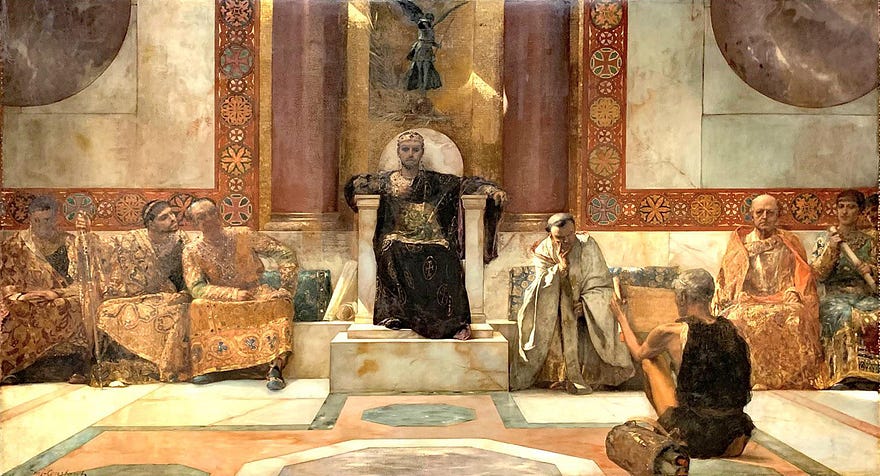
In 559 AD, Emperor Justinian I of Byzantium announced to the world that he had finally cracked the mystery of why earthquakes kept leveling his cities: gay men. Not geological faults. Not volcanic pressure. Gay. Men. Justinian was so convinced that male–male sex destabilized the cosmos that he wrote new laws prescribing (gulp) castration, exile, and execution to protect the empire from God’s wrath.
Meanwhile, lesbianism? Snooze. He didn’t bother mentioning it. The same ruler who believed gay men could topple the earth’s tectonic plates apparently couldn’t imagine two women generating enough friction to light a candle.
This is the oldest hypocrisy in the book. Authoritarians police male homosexuality with ritualistic ferocity while treating lesbianism as harmless, invisible, or pornographic. But to understand why gay men became such useful scapegoats, we have to go back to the sexual world Justinian inherited.
A Brief and Cheerful History of Ancient Sex
Before Justinian, same-sex desire was not automatically a supernatural threat. The Greeks did not think in modern categories like “gay,” “straight,” or “bisexual.” They thought in terms of roles, status, age, citizenship, and hierarchy.
In other words, the Greeks did not sort people by whom they desired. They sorted them by position — and I do not mean that in the Kama Sutra sense. Social position came first. Sexual position stood right behind it, smirking. What mattered was whether you ruled or yielded, pursued or submitted, and most importantly, whether you kept your masculine status or let it wander off-message in public.
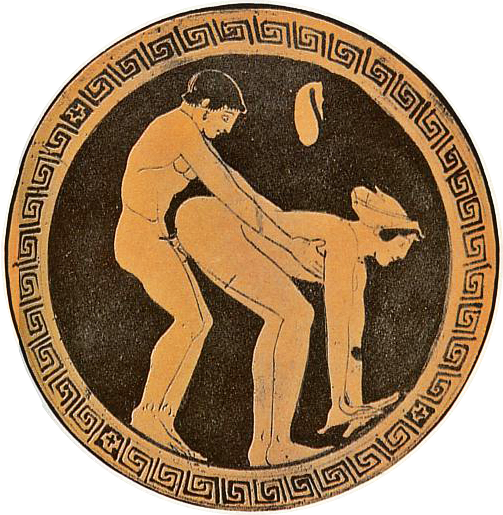
For example, a grown male citizen could bed men, women, and children, and remain a pillar of the community, so long as he ran the show. The formal version even had a name — paiderastia, a recognized bond between an older man and a younger one. Done well, respectable. Done badly, gossip. A crime, never. A summoner of earthquakes, certainly not.
Rome took that framework and gave it a harder jawline. A Roman citizen could sleep with men without necessarily losing status, so long as he remained the dominant partner.
Basically, the one unforgivable move was losing the top spot. Rome even had a slur for the men not jocking hard enough for the top — cinaedus. Not exactly “gay,” not exactly “bottom,” but something closer to Rome’s nightmare of failed masculinity: soft, suspect, receptive, and enjoying himself in all the wrong ways.
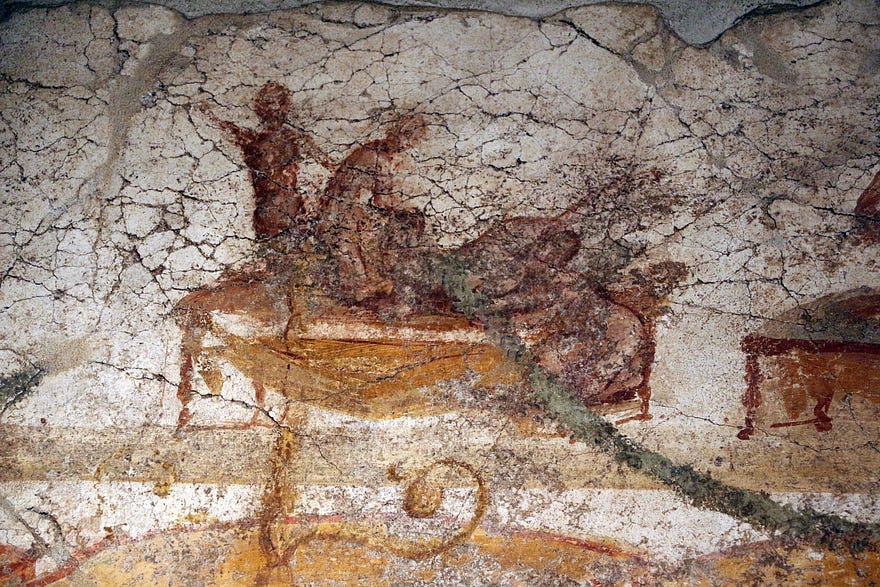

Women landed in satire for the same lane change. Not for desire, but for grabbing the wheel. Two women keeping each other company in the “feminine” mode could be beneath comment. But the tribas, from the Greek tribein, “to rub,” was the Roman name for a woman who took the active, “masculine” role in bed with another woman. She got the full roast.
The poet Martial mocked the satirical tribas Philaenis for exactly that reason. She dared to behave like a Roman bro. Philaenis hauled weights, out-drank men, and bedded girls and boys like she had a point to prove. Read the poem closely, and the joke is never simply that she desires women. The joke is that she is acting like a man. Worse, she is acting like a man with stamina.

None of this was strictly a European invention. A lot of the world looked at the same question Justinian was about to lose his mind over and shrugged.
In Persia, the poets swooned over beautiful young men, and the sky stayed firmly aloft. Rumi, Hafez, Saadi — page after page of medieval ghazals frolicking with the local heartthrob, and not a tectonic plate out of place.
Meanwhile, Persian women loving Persian women don’t make the poems. Persia, like a great many places, kept its eye trained firmly on the men — celebrating them in verse, or, in the older Zoroastrian tradition, condemning them in law. Either way, the women’s sexual preferences were nowhere on the page unless they attempted to disrupt the patriarchy.
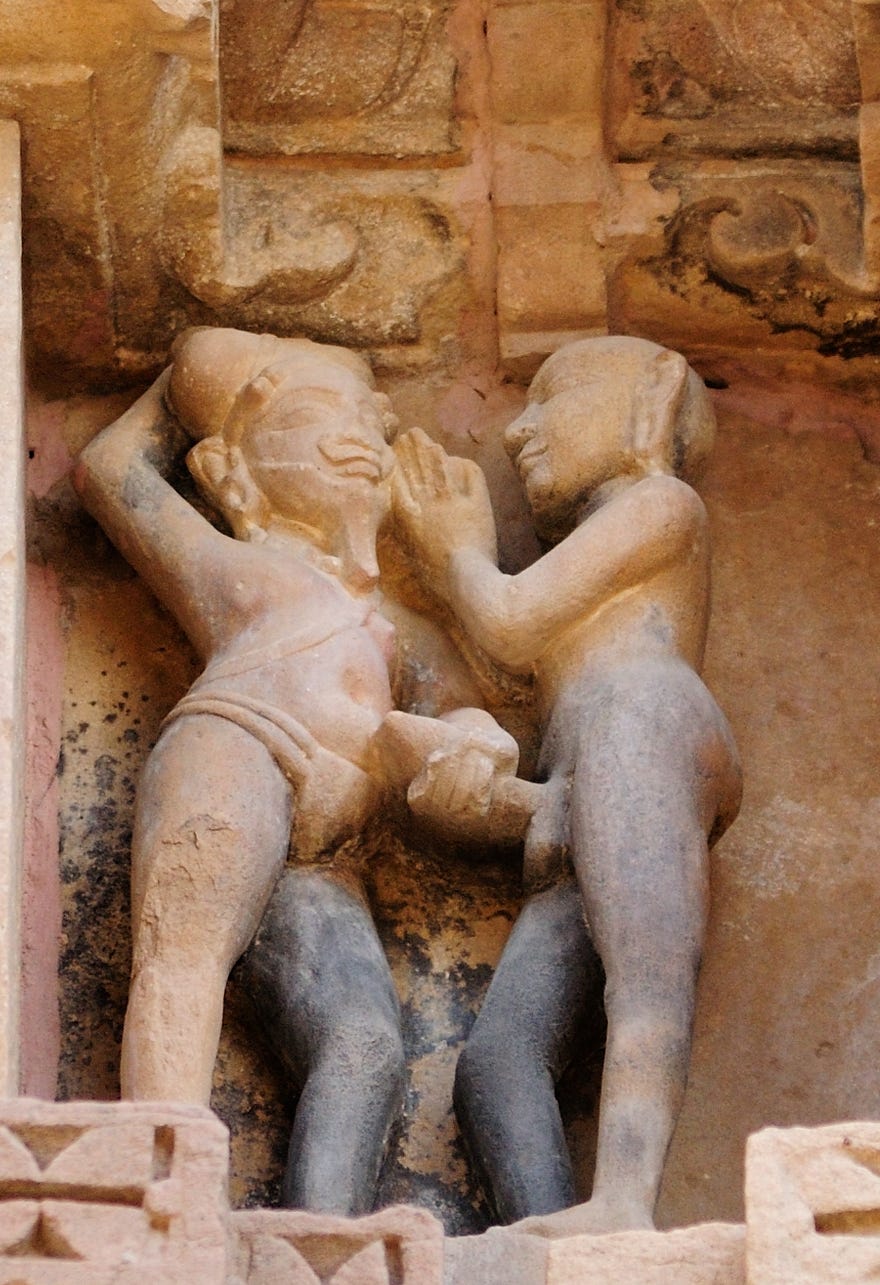

In India, texts like the Kama Sutra, usually dated around the 3rd or 4th century CE, described male-male sexual acts plainly — sometimes with practical advice. The Kama Sutra filed it all under “things people do” rather than “things that enrage heaven.” Vatsyayana even includes a section on what he calls women of a more masculine nature, which historians have spent the last century trying to translate without anyone fainting.
China went further than any of them and built love between men into the language. They called it “the passion of the cut sleeve,” after a Han-dynasty emperor named Ai who woke one morning to find his lover Dong Xian asleep across the sleeve of his robe. Rather than disturb him, Ai took a blade, cut the sleeve clean off, and slipped away. Two thousand years before the snooze button, a grown man destroyed good clothing to avoid waking his napping boyfriend. Adorable.
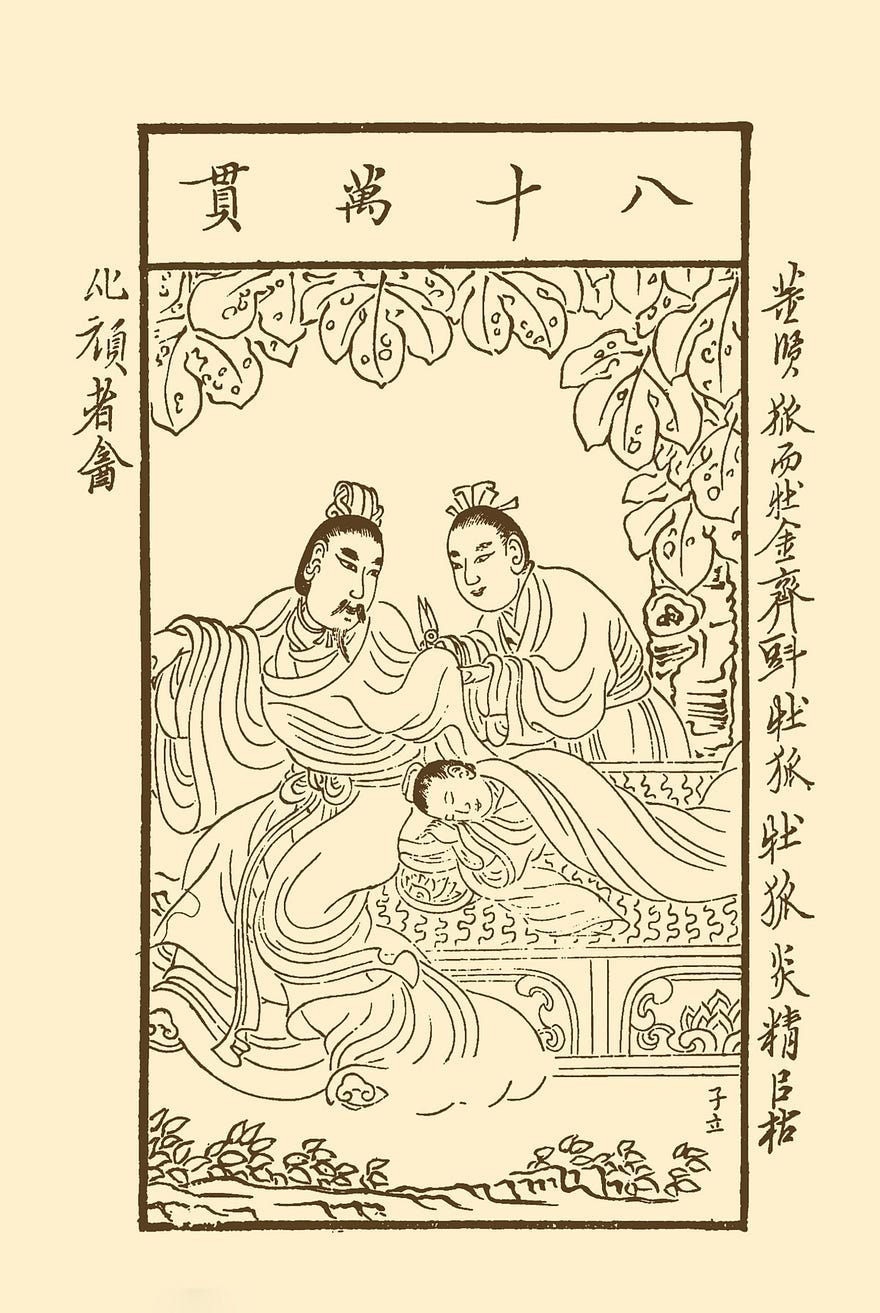

The Chinese historian Ying Shao, writing in the second century AD, gave the women their own word — duishi, “paired eating.” Translators have argued for over a hundred years about whether duishi is a polite euphemism for cunnilingus or simply means sharing a meal and a life. The argument may never be settled. Either way, women’s sexual appetites were not policed.
The Church Takes the Wheel (and Keeps It a Thousand Years)
Medieval Christianity took Justinian’s law and ran with it. Male sodomy became a capital crime. Male bodies, male desires, male confessions — all of it patrolled.
Women loving women? Mostly shrugged off as sad spinsters or a joke about lonely nuns. The penitentials mention it now and then, call it “unnatural,” but rarely bother with any punishment. The Church didn’t raise torture chambers to hunt lesbians. The machinery had a target, and it was men.
The exception proves it. When women were punished, the trigger usually wasn’t love — it was impersonating male authority: cross-dressing, marriage-like arrangements, or that recurring scandal…the artificial penis.
In 1477 in Speyer, Katherina Hetzeldorfer was tried for having sex with women using a leather device. The court read her not as a woman who loved women but as a trespasser into the male domain. She was drowned. Not for her sexual desires, but for wanting male stature.
The Enlightenment: Rationality for Some, Panic for Others
By the seventeenth and eighteenth centuries, Europe allegedly discovered reason. Candles were lit. Encyclopedias were compiled. Men in wigs began congratulating themselves for escaping superstition, while continuing to behave like exorcists whenever male sexuality slipped its leash.
Enlightenment thinkers increasingly framed sodomy as irrational, sterile, degenerate, wasteful, or “against nature.” The language changed from sin to nature, from demonology to medicine, from priestly condemnation to secular disgust. But the target remained familiar: men who failed to perform reproductive, dominant, orderly masculinity.
The policing wasn’t theoretical. In 1726, London constables raided Mother Clap’s molly house — a tavern in Holborn where men met other men. Three of the arrested were hanged at Tyburn. Margaret “Mother” Clap herself was pilloried and fined. Reason did not soften the rope.
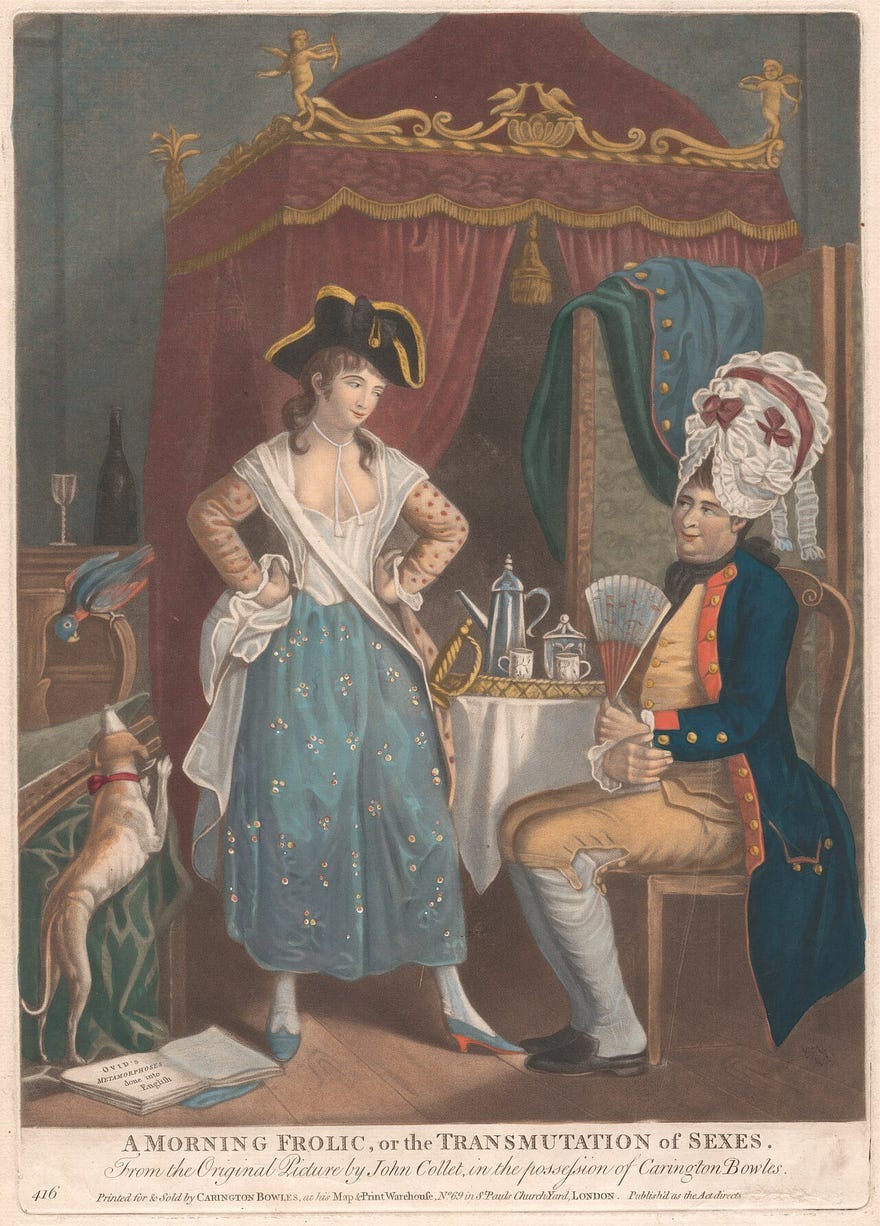
The era also proved the whole thing was a choice. In revolutionary France, the penal code of 1791, reaffirmed under Napoleon in 1810, simply stopped criminalizing sodomy between consenting adults. No earthquakes followed. The sky stayed up. Which tells you everything: where male homosexuality was policed, it was policed because someone in power wanted it policed.
Lesbianism, meanwhile, kept its historical blind spot for one reason. It didn’t threaten the Enlightenment’s favorite pyramid of property, inheritance, and politics flowing neatly along male lines.
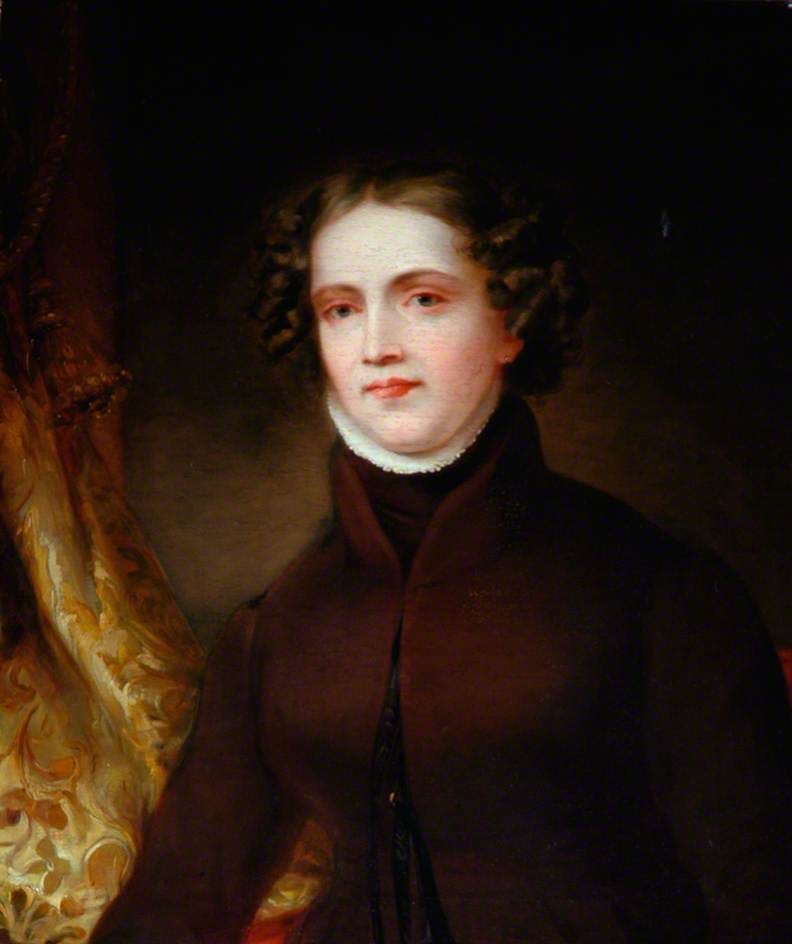
The proof is sitting in a Yorkshire diary. Anne Lister (1791–1840), known later as “Gentleman Jack,” inherited Shibden Hall, ran the estate herself, lived openly with a series of female partners, and in 1834 took communion with her partner Ann Walker as a private marriage. She was never prosecuted. She kept a coded journal detailing her affairs that runs to four million words, and she still died a respected landowner.
The system left her alone because she was not disturbing it. As long as a woman held the male position in the property pipeline, the Enlightenment was prepared to politely look the other way.
The Victorians: Peak Masculinity Panic
The Victorians turned respectable manhood into a fortress. Restraint, dominance, and the emotional range of a filing cabinet. Male homosexuality threatened the whole structure. If masculinity wasn’t rigid, then marriage, fatherhood, and empire were a three-legged chair.
This is where disgust finished putting on the lab coat. In 1869, the Hungarian journalist Karl-Maria Kertbeny coined a brand new word for an old anxiety: homosexual.
Within twenty years, the German sexologist Richard von Krafft-Ebing had cataloged it as a pathology in Psychopathia Sexualis (1886), alongside fetishism, sadism, and masochism, all newly minted diagnoses. The Victorians had taken what the Church once called sin and reissued it as a medical condition, complete with Latin, footnotes, and the implication of a cure. The very old conclusion that gay men were defective now arrived with a degree behind it.
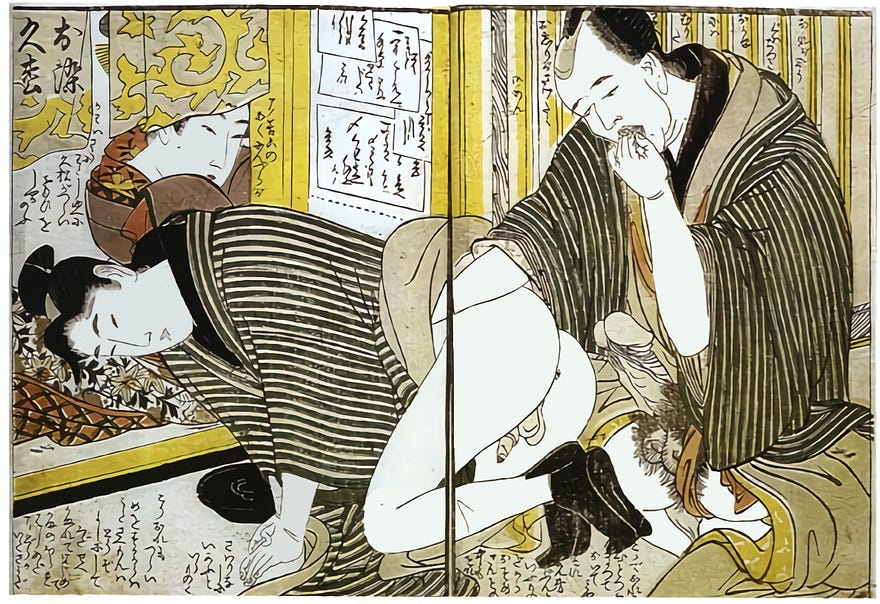
And here’s the hypocrisy at full volume. The same respectable Europe jailing gay men privately and avidly collected shunga — Japan’s erotic prints showing men with men, women with women, pleasure of every arrangement, all of it cheerful and unbothered. Degas owned some. So did Rodin and Toulouse-Lautrec. A gentleman could hang Japanese male-male eroticism in his private study and send an Englishman to prison for the same act before lunch. The objection was never the desire. It was his men doing it in plain view of the empire.

The women, meanwhile, kept their loophole. The popular story says Queen Victoria refused to believe lesbians existed. There is no evidence she did. The duller, worse truth is that Parliament grasped what naming lesbian sexuality would require: admitting women had sexuality.
So two women could build an entire life together and stay invisible. The Ladies of Llangollen managed nearly fifty years of it. Eleanor Butler and Sarah Ponsonby ran away together in 1778, set up house in a Welsh cottage, and entertained Wordsworth, Byron, and the Duke of Wellington as a respectable curiosity. The neighbors called them eccentric. Queen Charlotte sent them a pension.
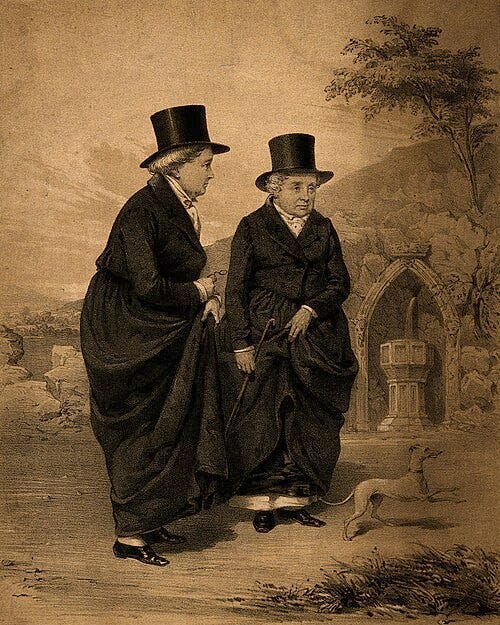

There were women having passionate, domestic, lifelong partnerships — what historians later called Boston marriages — where two women lived together, shared finances, raised children, and were widely rumored to be romantically and sexually involved. These relationships were often tolerated because two women building a life together didn’t disrupt the male pipeline of property and heirs. They were invisible to the state and, therefore, unthreatening.
Gay men got no such pass. Britain’s Labouchere Amendment (1885) criminalized “gross indecency” between men, vague enough to cover anything, useful enough to become a blackmailer’s dream. The amendment was tacked onto a bill ostensibly written to protect girls from sex trafficking. The clause about men was added by a member of Parliament who later denied caring much about the issue. Ten years later, it would put Oscar Wilde in Reading Gaol.
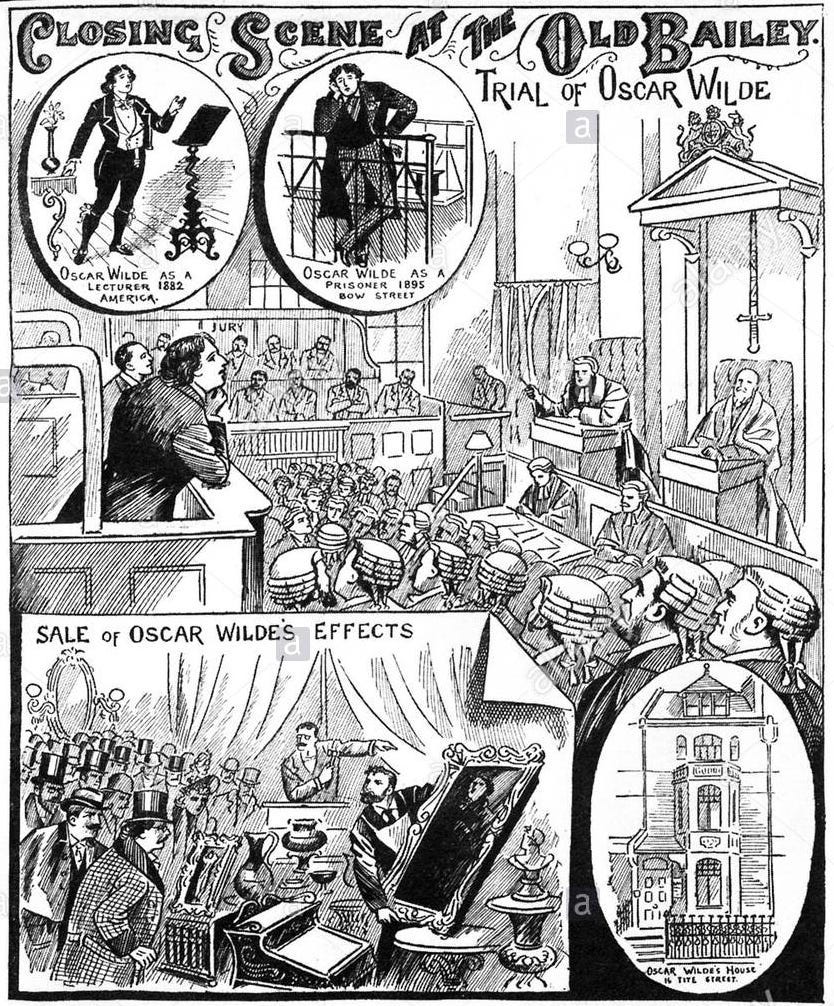
Wilde’s 1895 conviction turned gay desire into front-page theater. His letters, clothes, jokes, and dinner invitations were all dragged in as evidence. The prosecution read his prose aloud in court as if the sentences themselves were criminal. He served two years of hard labor, came out broken, and died in a Paris hotel in debt, under an assumed name. The modern gay man had become visible, and visibility came with police, doctors, and reporters pressed to the glass.
Then came Berlin.
Homosexuality with paperwork
In the 1920s, Berlin briefly became the glittering bad idea every authoritarian would later want to murder. Gay bars, lesbian clubs, drag balls, cabarets, queer magazines, and Magnus Hirschfeld’s Institute for Sexual Science made the city one of the most sexually open places in the world.
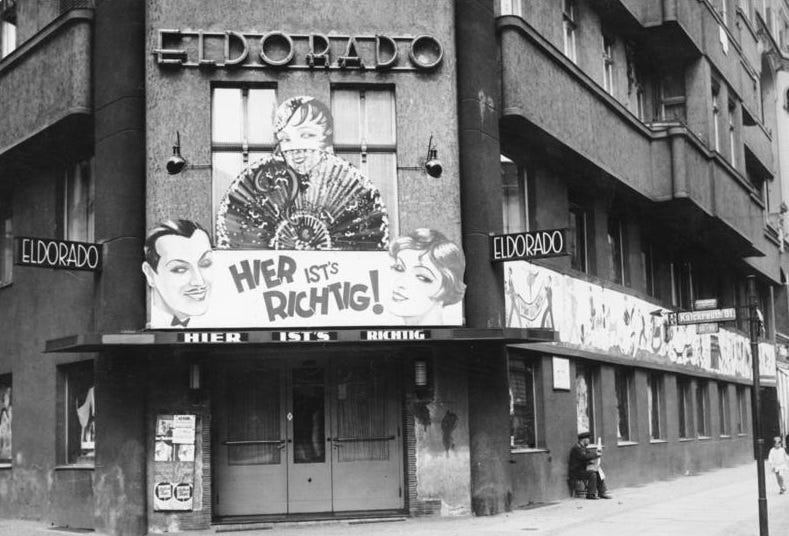

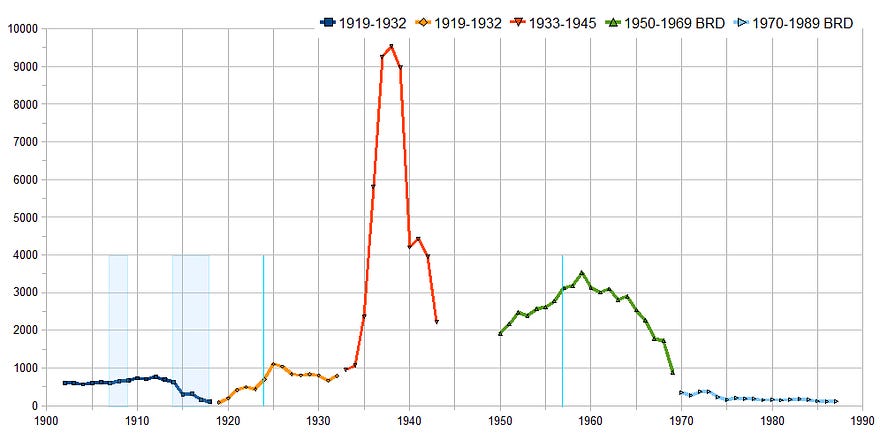
Nazi Germany did not invent laws against gay men. It just sharpened the ones already on the books. Paragraph 175, the German statute criminalizing sex between men, predated the regime by sixty years. In 1935, the Nazis broadened it. Between 1933 and 1945, roughly 100,000 men were arrested under it. About 50,000 were convicted. Between 5,000 and 15,000 were sent to concentration camps, wearing a pink triangle. Gay men died at rates among the highest of any prisoner category.
The equivalent statute for women was never written. The Nazis debated it in 1935 and explicitly declined. The reasoning was bureaucratic and chilling: a lesbian woman, unlike a gay man, could still be folded back into childbirth.
In 1936, Himmler created the Reich Central Office for Combating Homosexuality and Abortion. Read that title twice. The same office that hunted gay men was tasked with forcing women to bear children. The bureaucratic machinery itself encoded the asymmetry: men were the threat, women were the supply.
The regime’s logic was brutally reproductive. Women, even lesbian women, could still be forced, pressured, or folded back into the machinery of childbirth. Gay men, by contrast, were seen as failures of masculine duty: not soldiers, not fathers, not properly reproductive, not loyal to the male state. Authoritarianism needs men to behave like obedient bricks in the wall.
To be clear, the Nazis harassed and destroyed lesbian communities, too. Lesbian bars and publications were closed. Women who loved women could be persecuted as “asocial,” Jewish, communist, sex workers, political dissidents, or simply women who refused the approved script. But lesbianism itself was not treated as the same legal threat as male homosexuality.
America discovers the tasteful purge
After World War II, you might think democratic governments would have looked at the Nazi persecution of gay men and concluded, “Let’s not do that again.” Yeah, so that did not happen.
In the 1940s and 1950s, gay men were treated as security risks, moral weaklings, communists-in-waiting, or blackmail with shoes. The logic was circular: because homosexuality was criminalized and stigmatized, gay men could be blackmailed; therefore, the state had to expose and fire them before someone else exposed them and blackmailed them. It was persecution disguised as risk management.
This became known as the Lavender Scare — McCarthyism’s prissier but equally vicious cousin. In 1950, a Senate report declared homosexuals “unsuitable” for federal employment and security risks in positions of public trust.
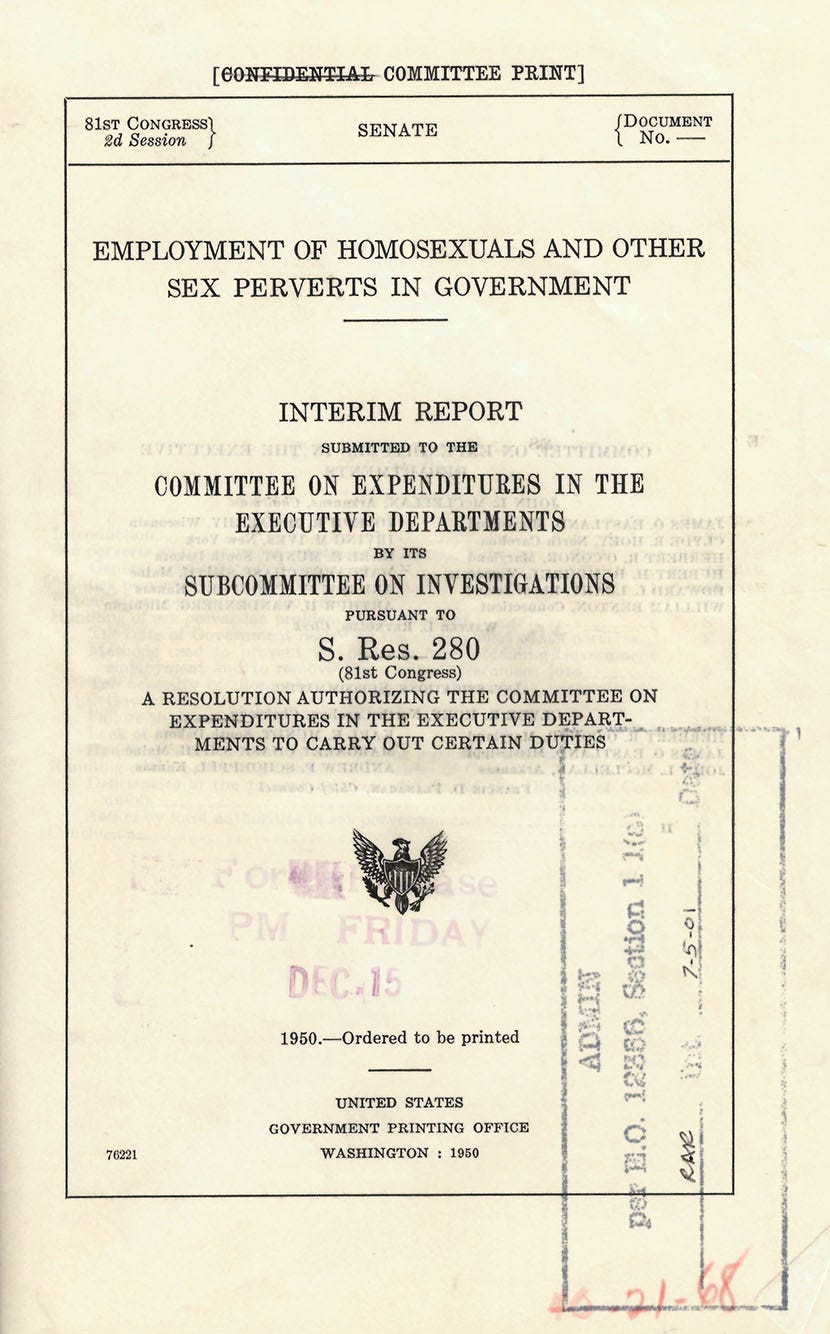
In 1953, Eisenhower’s Executive Order 10450 formalized the purge. Between 1947 and the late 1960s, approximately 5,000 to 10,000 federal workers lost their jobs. At the peak of the firings, men outnumbered women roughly three to one.
The men who were fired were the ones who ran the Cold War: State Department officers, military officers, scientists, intelligence analysts, or any jobs requiring security clearance. The government’s logic was clear in who it targeted hardest. Gay men held the keys, so gay men had to go.
The military made the asymmetry explicit. Tens of thousands of personnel were discharged for homosexuality during and after WWII. Men received “blue discharges” or undesirable discharges that destroyed civilian careers, stripped GI Bill benefits, and followed them on every job application for the rest of their lives.
Lesbians were fired too, but the bureaucracy treated them as a lesser threat. Most lesbians were quietly mustered out. The state wanted gay men gone permanently, and gay women redirected toward husbands.
Outside Washington, the same logic ran on the streets. Police departments in major cities sent plainclothes officers into bars, parks, and public restrooms to solicit gay men and arrest them. Newspapers published the names. Careers ended. Suicides followed.
There was no equivalent program targeting lesbians. Vice squads did not stake out women’s get-togethers with the same systematic intent because lesbian socializing was not seen as a public order threat. Men gathering to find each other was treated as an infrastructure problem requiring infrastructure to dismantle.
Hypocritically, this “gay men are a blackmail risk” logic is not being applied to today’s very compromised Epstein clients. Apparently, 1950s and 60s gay men could be exploited and pressured, but today’s pedophiles are safe within the system.
Homosexuality has never been policed because of sex.
The double standard was never really about sex. It was about hierarchy. Male homosexuality threatened masculinity, inheritance, military order, paternal authority, and the brittle little fiction that men are naturally born to dominate.
Female homosexuality was often ignored, not because patriarchy was tolerant, but because patriarchy was arrogant. Women’s desire simply didn’t count unless a penis had clocked in for work.
Superstitions fed the phobia. Justinian blamed earthquakes on gay men because he lived in an age without geology. We don’t have that excuse today. We have science. We have data. And yet Conservatives are still superstitious enough to believe that gay men can be “reprogrammed,” as if sexuality is a switch you can flip back to straight.
Today’s authoritarians won’t blame natural disasters on gay men. Not yet. They’ll blame school shootings, demographic decline, military weakness, civic decay, or whatever “woke” crisis is convenient. The target will shift, the accusation will modernize, but the instinct remains the same: find the men who don’t follow the script and make them pay for it.
But here’s the trick that the transphobic tribe always misses: Once you are policing one group’s sexuality, it is only a matter of time before you are policing everyone’s sexuality.

Carlyn Beccia is an award-winning author and illustrator of 13 books. The Grim Historian is a reader-supported publication. To receive new posts and support my work, consider becoming a free or paid subscriber.
That part about Himmler’s office to combat homosexuals and abortion made me immediately connect it with the White Christian Nationalist’s who put us in the situation we’re in- ultimately for the very same reasons: gay marriage and abortion
I think this is a perfect explanation as to why Trans Men as seen as less of a threat to conservatives than Trans Women and why for the most part Trans Men are completely left out of trans conversations. The patriarchy will never see trans men as real men and thus will never find them threatening. You always hear conversations about "men in women's sports" and "men in women's bathrooms" but never the other way around, even though there's just as many trans men as there are trans women. Thank you for writing this!