


Grim Reminder: A Grim Historian is a reader-supported newsletter and depends on your 5$ donations to keep the most depressing politics and history in your inbox. Please consider becoming a paid subscriber or sharing with someone who loves misery.
A year ago, I wrote a piece predicting the Trump regime would start a war with Iran. I connected the money, the donors, the shredded arms deals, the whole beautiful constellation of people who stood to profit.
Nobody read it.
And I don’t mean it underperformed. I mean, it got fewer clicks than a recipe for unseasoned chicken. My article about Pete Hegseth’s religious sermon outperformed it, and that piece was essentially a book report on a man who thinks the Crusades got a bad rap.
So here I am. The Cassandra of Substack. Wagging my finger once again in an empty room, and the room is now on fire, and I am not too old or too tired to say: I told you. I told you, I told you, I told you.
Now the invoice just came due, and some of you are still out here acting like Trump and his flying monkeys got up one day and ordered war off the chaos menu.
This war wasn’t unplanned. It wasn’t even a reaction or overreaction to anything. It was a purchase order — years in the making, signed in installments, with the receipts literally held up for cameras in the Oval Office.
So if you want to understand how America ended up in another Middle Eastern war, follow the money. It has never once lied to you.
The First Receipt: Riyadh, 2017
Donald Trump’s very first trip abroad as president wasn’t to a NATO ally. It wasn’t to Canada, Mexico, or Japan. It was to Saudi Arabia. And the centerpiece wasn’t diplomacy — it was a $110 billion arms deal, with $350 billion more promised over a decade. Trump called it “tremendous.” The White House called it “historic.”
The defense industry called their brokers.
There was just one problem: most of it wasn’t real. A former CIA officer at the Brookings Institution examined the deal and called the headline number something that “doesn’t really exist” — a collection of letters of intent, wish lists, and aspirational agreements rather than binding contracts. By 2018, CNN reported that only about $14.5 billion had actually materialized. The $110 billion was a fantasy number designed for a press conference.
But here’s the thing about fantasy numbers in Washington: real weapons still flow underneath them. Real contracts still get signed. Real bombs still get built.
Oh, and one more detail about that 2017 trip. The deal was partially brokered by Jared Kushner, who had personally cultivated relationships with Saudi royals during the transition and directly contacted Lockheed Martin during the deal-making process. Put a pin in that one. We’ll come back to it.
The Poster Board: Washington, 2018
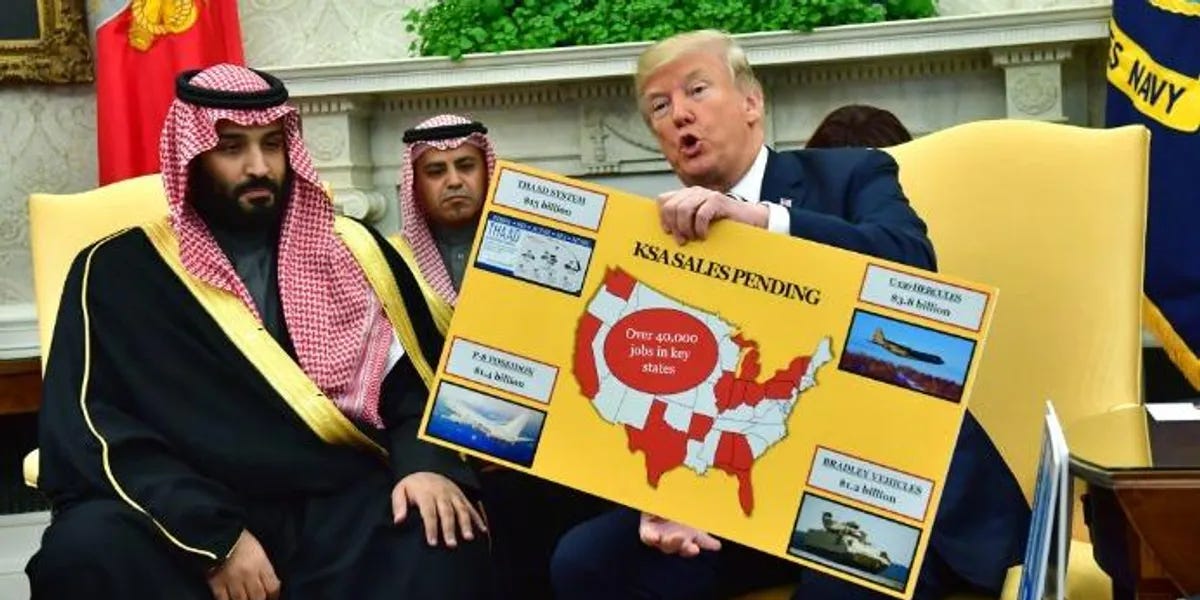
This is the image that should be seared into the public record.
On March 20, 2018, Trump sat in the Oval Office next to Saudi Crown Prince Mohammed bin Salman and held up a bright yellow poster board — the kind you’d buy at a Walgreens for a middle school science fair — listing military hardware with dollar amounts. “KSA SALES PENDING,” it read. THAAD missile systems, $13 billion. F-15 fighter jets, $4.4 billion. C-130 Hercules transport planes, $3.8 billion. Bradley fighting vehicles, $1.2 billion.
And right there in the center: a map of the United States with a red bubble that said “Over 40,000 jobs in key states.”
Key states. Not all states. Not “the American economy broadly.” Key states. The ones that show up on an electoral map. The President of the United States reduced his entire arms-sales foreign policy to a campaign graphic, held it up for the press pool, and grinned.
The word “PENDING” was doing important work on that board. These weren’t completed sales. This was a menu. Trump was showing MBS what was available for purchase — in the Oval Office, on camera, with the seal of the presidency behind him. It wasn’t statecraft. It was a pitch meeting.
Seven months later, Jamal Khashoggi — a Washington Post columnist and U.S. resident — walked into the Saudi consulate in Istanbul and was murdered and dismembered by a team linked to MBS. U.S. intelligence determined the crown prince had ordered the killing. Trump’s response? We have deals pending. Can’t jeopardize the relationship.
The poster board told you everything you needed to know about what that relationship was worth, and what it would excuse.
What the Poster Board Bought
Five months after Trump held up that board, in August 2018, a laser-guided Mark 82 bomb — sold by the United States, built by Lockheed Martin — was dropped by the Saudi-led coalition on a school bus in northern Yemen. It killed 51 people, including 40 children.
That bomb was on the poster board. Not literally — you won’t find “school bus bomb” listed between the THAAD system and the Bradley vehicles. But the pipeline that produced it, the sale that enabled it, the relationship that protected it — all of that was right there in the dollar amounts Trump was waving around for cameras.
When U.S. military officials raised concerns about Saudi pilots flying at high altitudes to avoid enemy fire — resulting in wildly inaccurate bombings that killed civilians — the U.S. suggested putting cameras on the warplanes to monitor strikes. The Saudis said no. The UAE said no. And the sales continued.
The Coalition of the Willing-to-Write-Checks
Now, zoom out, because this was never about one man or one deal. This was a convergence of interests so aligned that it barely needed coordination.
Sheldon Adelson — the single largest Republican donor before his death — explicitly and publicly advocated for bombing Iran. Not sanctions. Not diplomacy. Bombing. John Bolton, Trump’s former National Security Advisor, has spent decades arguing for military strikes against Tehran. MBS and the Saudi government need Iran neutralized as a regional competitor — and they’ve been willing to pay handsomely for American muscle to do it. The evangelical Christian Zionist base views Iran through a Biblical eschatological lens where conflict isn’t just acceptable, it’s prophesied.
And then there’s the defense industry. Lockheed Martin, Raytheon, Northrop Grumman, Boeing, General Dynamics — their stocks don’t just rise during wars. They surge on the anticipation of wars. Every saber rattled, every “all options are on the table,” every carrier group redeployed to the Gulf is a buy signal.
But forget the obvious profits. It’s the secondary markets that really fatten wallets. After you demonstrate what your weapons do to Iran, you turn around and sell them to every Gulf state that's now terrified of retaliation. Saudi Arabia, UAE, Bahrain, Kuwait — they all go on shopping sprees.
These aren’t separate interests operating independently. They’re a coalition — donors, defense contractors, Gulf allies, and ideological true believers — and every node in that network has been pointing at the same target for years. Iran. The only question was when, and who would be in office to sign the order.
The $142 Billion Update
In May 2025, Trump returned to Saudi Arabia — his first foreign trip of his second term, just as it had been in his first. This time, the arms deal was $142 billion—the largest defense sales agreement in history, and part of a broader $600 billion Saudi investment package. Elon Musk and Larry Fink were there. The fact sheet used the word “historic” like it was punctuation.
And Jared Kushner? The son-in-law who brokered the original 2017 deal, who cultivated MBS personally, who called Lockheed Martin directly? He’d already collected $2 billion from Saudi Arabia’s sovereign wealth fund for his private equity firm. Not a government contract. Not a policy role. A direct, personal payout from the people buying the weapons.
The three countries on Trump’s itinerary — Saudi Arabia, Qatar, and the United Arab Emirates — are also places where the Trump Organization, run by the president’s two oldest sons, is developing major real estate projects. But I’m sure that’s a coincidence. Everything is always a coincidence until the receipts show up.
The Invoice Comes Due
So when someone tells you this war wasn’t planned and Trump is just making decisions on the fly, show them the poster board. Show them the $110 billion fantasy that still managed to kill 40 children on a school bus. Show them the $142 billion update. Show them the donor network, the defense stocks, the $2 billion wire to the president’s son-in-law.
This war was always the plan. It was purchased in installments, brokered by family members, sold to the public as a jobs program, and protected from accountability by the very profits it generated. The only thing that was ever “pending” was the timing.

Carlyn Beccia is an award-winning author and illustrator of 13 books. The Grim Historian is a reader-supported publication. To receive new posts and support my work, consider becoming a free or paid subscriber.
Netanyahu has spent 35 years trying to get a US President to partner with such a strike. It is surprising that it took this long to be frank.
Bibi knows that he can get Trump to do anything with whispering about turning Gaza into a resort that is headlined with Trump properties.
Thank you for not putting this story behind a paywall.