


Grim reminder: Defending democracy takes work. It takes hours of research, relentless fact-checking, and people willing to challenge abuses of power long after the headlines disappear. Independent journalism is part of that fight, and paid subscriptions keep this work going. If you believe democracy is worth defending, please consider becoming a paid subscriber.
In April 2025, The New York Times assembled 13 Independents who had voted for Donald Trump and asked them how things were going.
Their responses exposed a level of civic illiteracy that I haven’t seen since Dan Quayle taught a sixth grader how to misspell potato.
Consider Mike, a 52-year-old ride-share driver from Nevada. Mike was worried about the national debt. A perfectly reasonable concern. He thought the government needed to stop spending money it didn’t have. Also reasonable.
But when the moderators asked whether the government should make cuts carefully to protect medical research, airline safety, and food safety, Mike preferred aggressive cuts, even if important federal programs suffered.
His proposed solution was to “take the chain saw.”
Wonderful, Mike. The Food and Drug Administration can fish fingers out of our meatpacking industry and glue them back on later.
Then there was Jordan, a 38-year-old homemaker from Utah. Jordan predicted that Trump’s economic policies would cause hardship but would create a “more even playing field.” Jordan was prepared to endure pain if she saw her neighbors suffer enough. She even praised Trump for “following through on the things that he actually did say he was going to do,” adding, “I had my eyes open when I voted for Trump, that it was going to hurt.”
Well, no one can accuse Jordan of not reading the fine print.
Jordan was also confident Trump wouldn’t touch Social Security because that would be “stupid.”
Too bad the Trump regime eliminated 7,000 jobs at the Social Security Administration…before this interview. Jordan, have you tried calling Social Security? It still exists, if you can get your check.
Then there is Angela, a 32-year-old assistant from Michigan, and another fascinating case study in how many useful idiots it takes to screw a country. Angela predicted tariffs would bring manufacturing home, and other countries would finally respect us. According to Angela, if they had to hurt a little for America to win, so be it.
When should we tell Angela that factory employment has fallen by more than 21,000 jobs since Trump took office? The leopards don’t check passports.
John, a 29-year-old construction manager from Texas, also gave Trump a gold star. He liked Trump’s more aggressive approach to governing and described the president’s second term as being increasingly about power. (Translation: John has not had sex since the Eisenhower administration.)
Oh, John had one complaint. Some of John’s friends had been deported. John was sad about that. It sucks to be John’s friends. But John still approved of Trump because he was doing what he said he would do. Apparently, John’s moral arc bends in the direction that suits him.
Are you catching a theme? Trump voters think a strong leader takes others down a peg.
All 13 participants said they would vote the same way again.
Of course, a focus group of the 13 dumbest voters in America can’t tell us what millions of other MAGAmuffins believe, but their answers expose a crack in the social contract. Mike would accept the chainsaw as long as it didn’t cut him. Jordan would accept pain as long as it evened the field. John would accept losing his friends as long as he wasn’t on the plane.
Somewhere along the way, the American experiment in self-government picked up a heavy emphasis on self.
That raises a question we don’t ask often enough before casting our ballot. When you vote, who are you voting for?
The founders had an answer. One of them had to put on his glasses to deliver it.
George Washington goes blind trying to save America
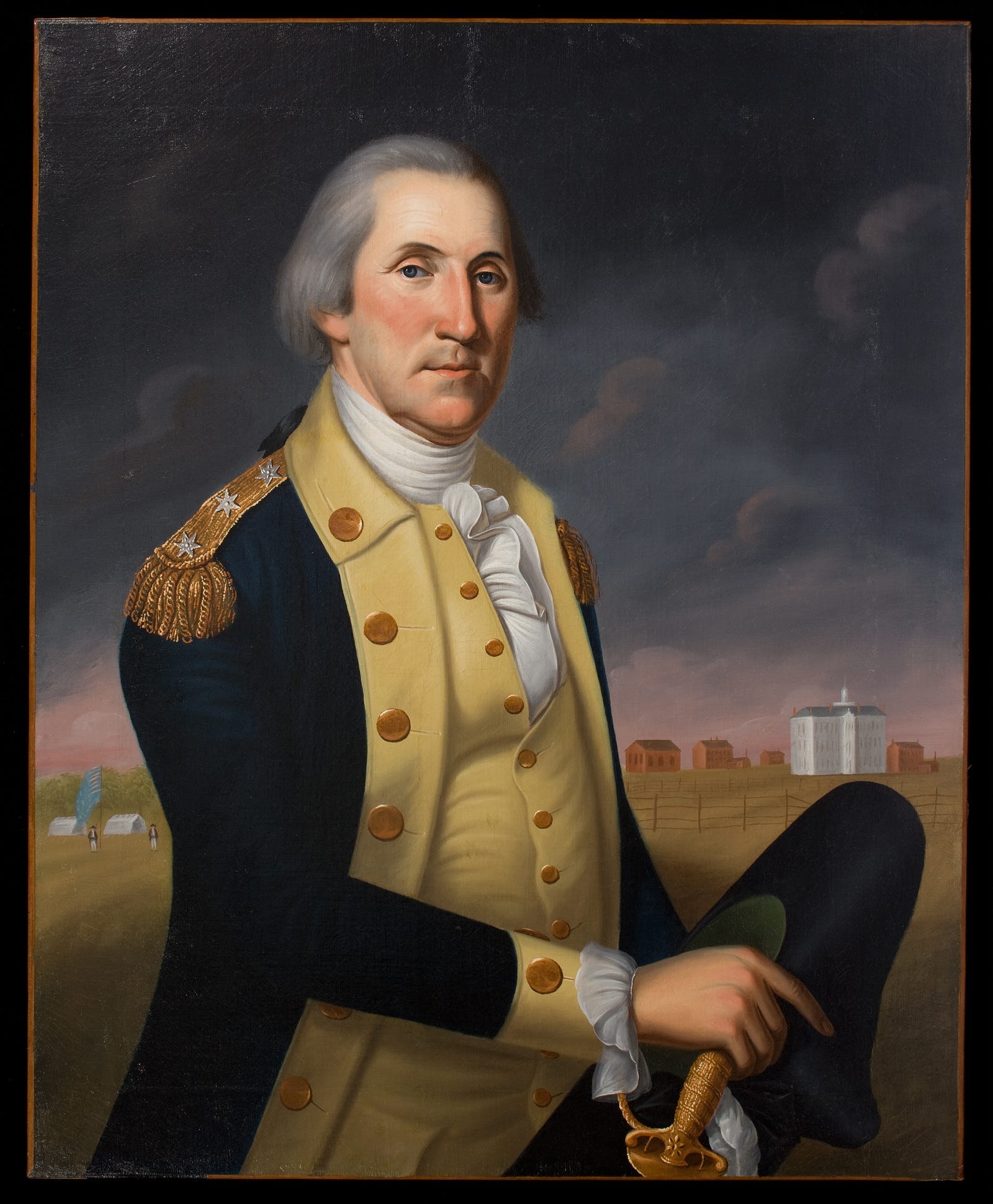
On a cold March morning in 1783, George Washington walked into a large wooden hall his officers had built at their winter camp near Newburgh, New York. They called it the Temple of Virtue. The men inside were not feeling virtuous.
They had won the war, but nobody had paid the soldiers who fought it. Some officers hadn’t seen wages in years. Congress had promised them half-pay for life, and then admitted it couldn’t afford that either. An anonymous letter circulated through camp urging the army to refuse to disband until Congress paid up.
Washington read a prepared speech, and it bombed. So he took out a letter from a congressman, squinted at it, and reached into his coat for a pair of reading glasses most of the men had never seen.
“Gentlemen, you will permit me to put on my spectacles,” he said, “for I have not only grown gray but almost blind in the service of my country.” It was a rare moment from a man who never complained about the hardships he endured.
Grown men wept, and the mutiny dissolved.
It’s a poignant story, but spectacles don’t pay soldiers. Under the Articles of Confederation, Congress couldn’t tax anyone. It could only ask. It sent the states polite bills, and the states treated them like a jury summons. The country owed roughly $42 million to French allies, Dutch bankers, and its own veterans.
So Congress found a fix — a modest 5 percent tax on imports. Every state had to agree. Twelve did. Rhode Island, which profited nicely from goods passing through its ports, voted unanimously no. A state of about 50,000 people blocked the country’s financial survival because the deal didn’t do enough for Rhode Island.
That June, from a fieldstone farmhouse in Newburgh, Washington wrote a circular letter to the states, laying out four principles he believed essential to the United States’ survival.
The first three concerned national unity, public justice, and maintaining peace.
The fourth concerned the character of the American people.
Washington believed the republic required citizens who could overcome local prejudices, make concessions to one another, and sometimes, “sacrifice their individual advantages to the interest of the Community.”
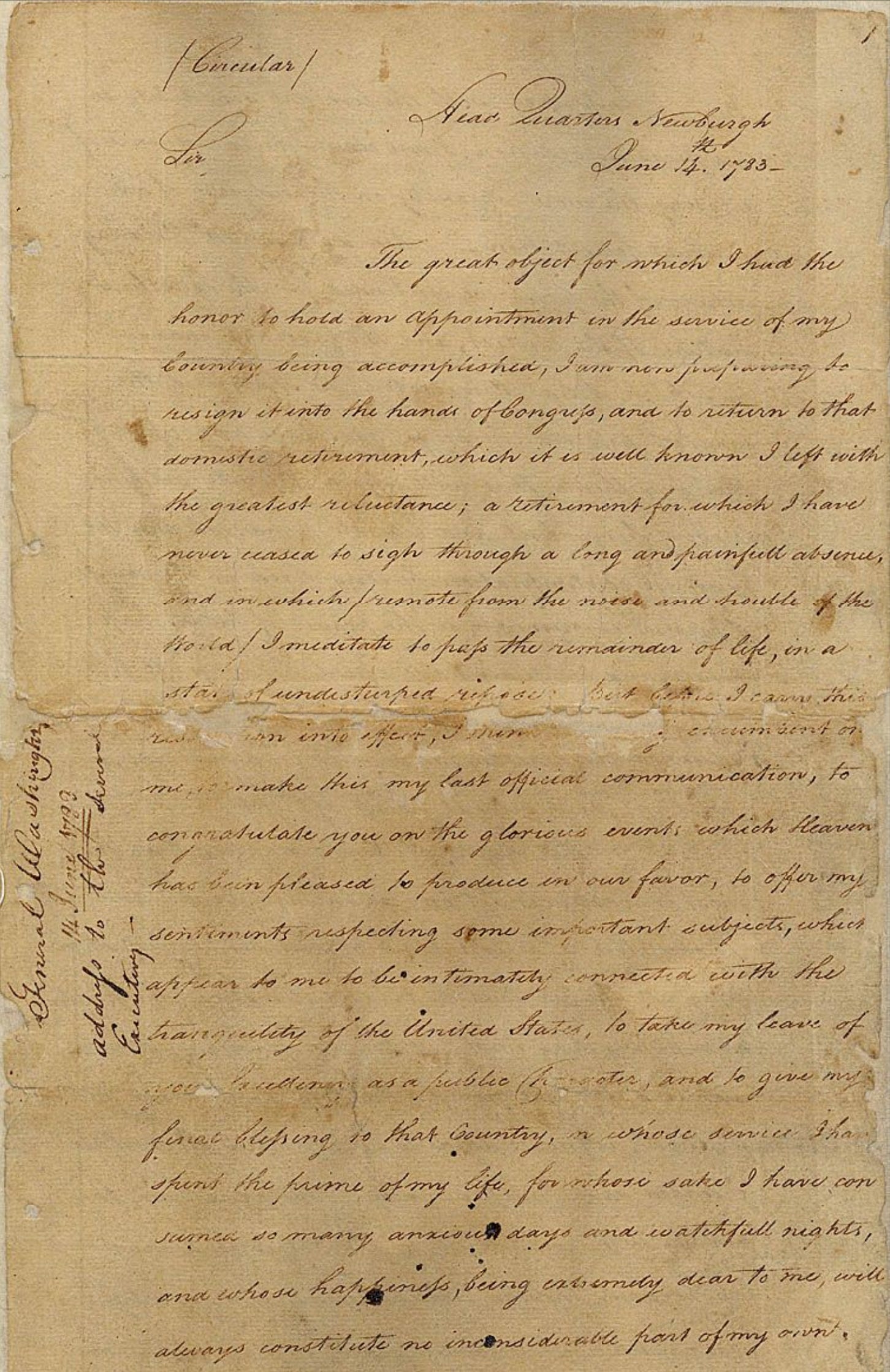
There it is. Community with a capital C. The father of our country believed the survival of the republic depended partly on Americans’ willingness to surrender personal advantages when the larger community required it.
John Locke used the word community in the same way. Individuals give up a slice of their natural liberty, and in exchange they form a community that protects all of them. In other words, you surrender a little so that everyone, including you, gets something no one could secure alone.
You probably guessed why I used the term “A Republic of Me” in my headline. It’s a contradiction in terms. The word republic comes from the Latin res publica, “the public thing.”
Washington didn’t invent this definition. He inherited it from a tradition running back to Rome, which taught that republics are fragile and survive only as long as their citizens have virtue. In that tradition, virtue had nothing to do with chastity. It meant a citizen’s willingness to put the public good ahead of his own.
Montesquieu, the French philosopher the founders practically memorized, wrote that republics run on virtue, which demands “a constant preference of public to private interest.” Washington was nearly paraphrasing him.
Six months after the circular, Washington resigned his commission and went home to his farm. The world started calling him the American Cincinnatus, after the Roman who was handed absolute power, saved the republic, and went back to his plow.
But the government still didn’t pay. Many soldiers went home with IOUs and sold them to speculators for pennies on the dollar. That’s the part the history books omit.
We will return to that broken promise later.
James Madison predicts MAGA
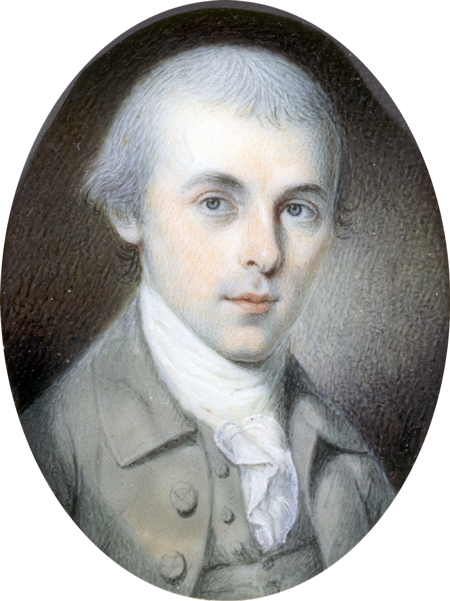
Four years later, in the spring of 1787, a small, sickly Virginian arrived in Philadelphia weeks before anyone else. James Madison stood about five foot four and looked as if a stiff wind would carry him to New Jersey. He had spent the winter reading histories of every failed republic he could find. He brought a memo.
He called it “Vices of the Political System of the United States,” and it was an indictment. The states ignored Congress’s requisitions. They passed laws that helped their own citizens at their neighbors’ expense. Worst of all, majorities inside the states were using their power to trample the rights of minorities.
Madison had watched Washington’s appeal to virtue fail. He didn’t conclude that virtue was unimportant. He concluded you couldn’t build a country that depended on it.
Rhode Island, true to form, refused to send anyone to the convention.
So after a summer of arguing behind closed windows, Madison sat down that fall to defend what they had built. In Federalist №10, he named the disease. He wrote that a faction is a group of citizens “united and actuated by some common impulse of passion, or of interest, adverse to the rights of other citizens, or to the permanent and aggregate interests of the community.”
There’s Washington’s word again: community.
Read the definition slowly and think of our MAGAmuffins—Mike, Jordan, and John. A faction isn’t just a group with strong opinions. A faction is a group whose interests run against other citizens’ rights or against the good of the whole.
Madison’s nightmare wasn’t a king. It was a majority that discovers it can vote away someone else’s rights and pay nothing for it.
His solution was ingenious and slightly cynical. If people won’t reliably sacrifice for the community, simply build a system where ambition checks ambition. “If men were angels,” he wrote in Federalist №51, “no government would be necessary.” Since they aren’t, you split power among branches, set each branch against the others, and trust that a Congress jealous of its own authority will stop a president who reaches too far.
Madison planned for selfish citizens. What he never fully planned for was selfish citizens and a Congress that stopped acting like a rival branch. He didn’t foresee what we have now — a Republican-led legislature willing to give its power away to stay in a president’s favor.
Washington hoped for virtue. Madison built a backup system for when virtue ran out.
In 2026, both are failing at once.
“People who are hungry and out of a job are the stuff of which dictatorships are made. “
— FDR, State of the Union address
FDR understood the other half—The forgotten man
On the evening of April 14, 1938, Franklin Roosevelt sat at a microphone to speak to Americans. Four weeks earlier, Hitler’s army had rolled into Austria without firing a shot. At home, the recovery had collapsed into a brutal recession, and millions of Americans who had just found work were losing it again.
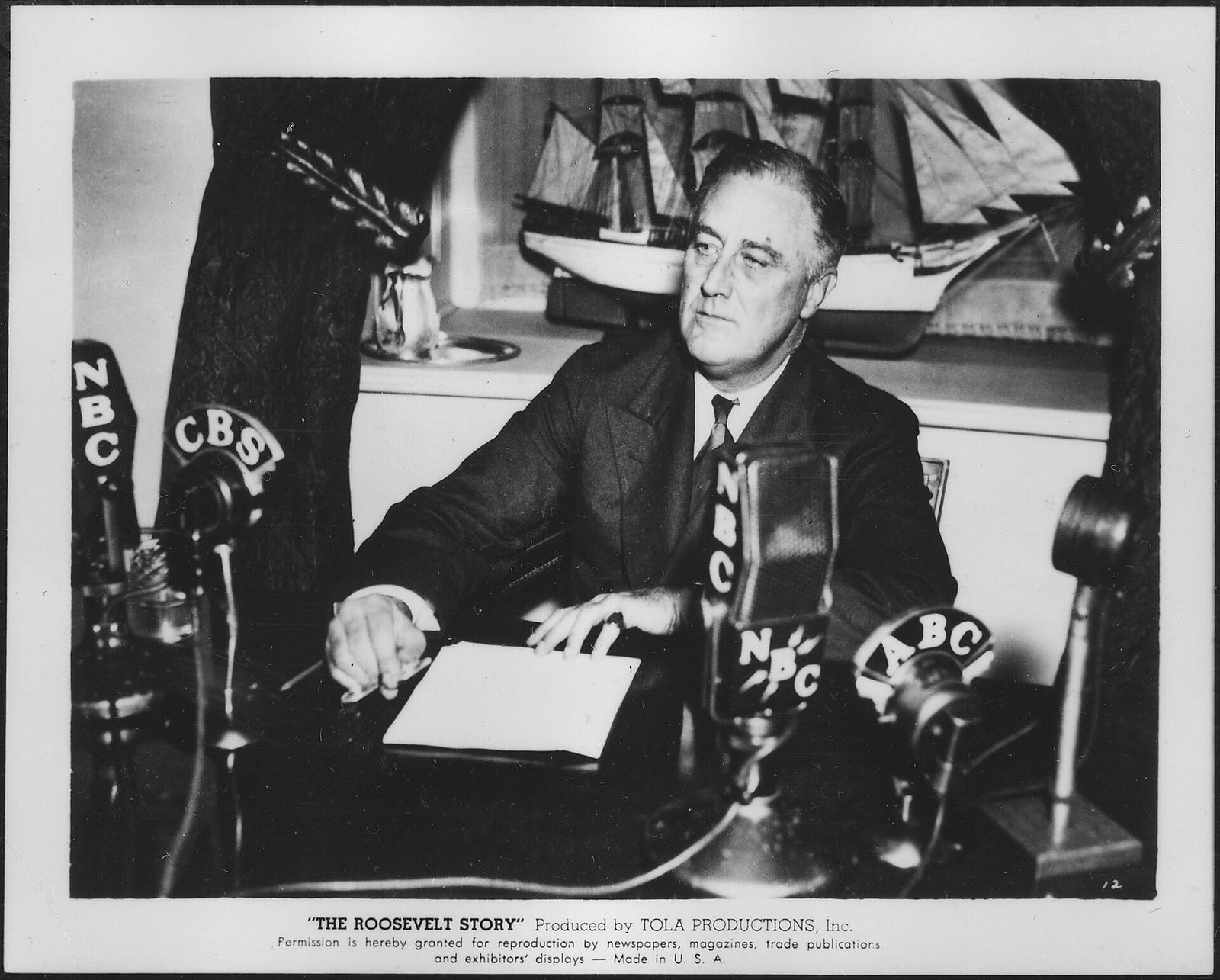
Roosevelt warned his listeners, “Democracy has disappeared in several other great nations.” He exclaimed that it was “not because the people of those nations disliked democracy, but because they had grown tired of unemployment and insecurity, of seeing their children hungry while they sat helpless in the face of government confusion and government weakness.”
Washington and Madison had worried about what citizens owed the republic. Roosevelt saw the other side of the ledger.
Years earlier, in a 1932 radio address, Roosevelt had called for a government that would “put their faith once more in the forgotten man at the bottom of the economic pyramid.” Eighty-five years later, Donald Trump borrowed the phrase for his inaugural address, promising that “the forgotten men and women of our country will be forgotten no longer.” Roosevelt meant everyone left behind. His MAGA voters heard it as a promise about themselves.
In 1944, sick with the flu and too ill to address Congress in person, FDR delivered his State of the Union as a radio address. In it he proposed a second Bill of Rights.
The first had protected Americans from their government: speech, worship, trial by jury. Roosevelt argued that those freedoms become abstract to people whose survival is always in doubt. He proposed rights to a useful job, a decent home, adequate medical care, a good education, and protection from the economic fears of old age, sickness, and unemployment.
“Necessitous men are not free men,” he said. “People who are hungry and out of a job are the stuff of which dictatorships are made.”
FDR asked— what good is the freedom to pursue happiness if you’re too hungry, sick, or broke to pursue anything?
This is where the knife turns. Washington’s bargain was never one-way. His own list included “public Justice,” the republic paying what it owed the people who had sacrificed for it. Roosevelt rescued that neglected half. A republic can ask its citizens to sacrifice, but it can’t ask for the sacrifice to become a death sentence.
Look at both halves of the social contract.
When people spend decades hearing that hard work buys stability and then live from one financial emergency to the next, they stop believing the system can deliver. So when a strongman shows up promising to rescue them by hurting others, don’t be surprised if they clap for the cruelty.
Why we vote
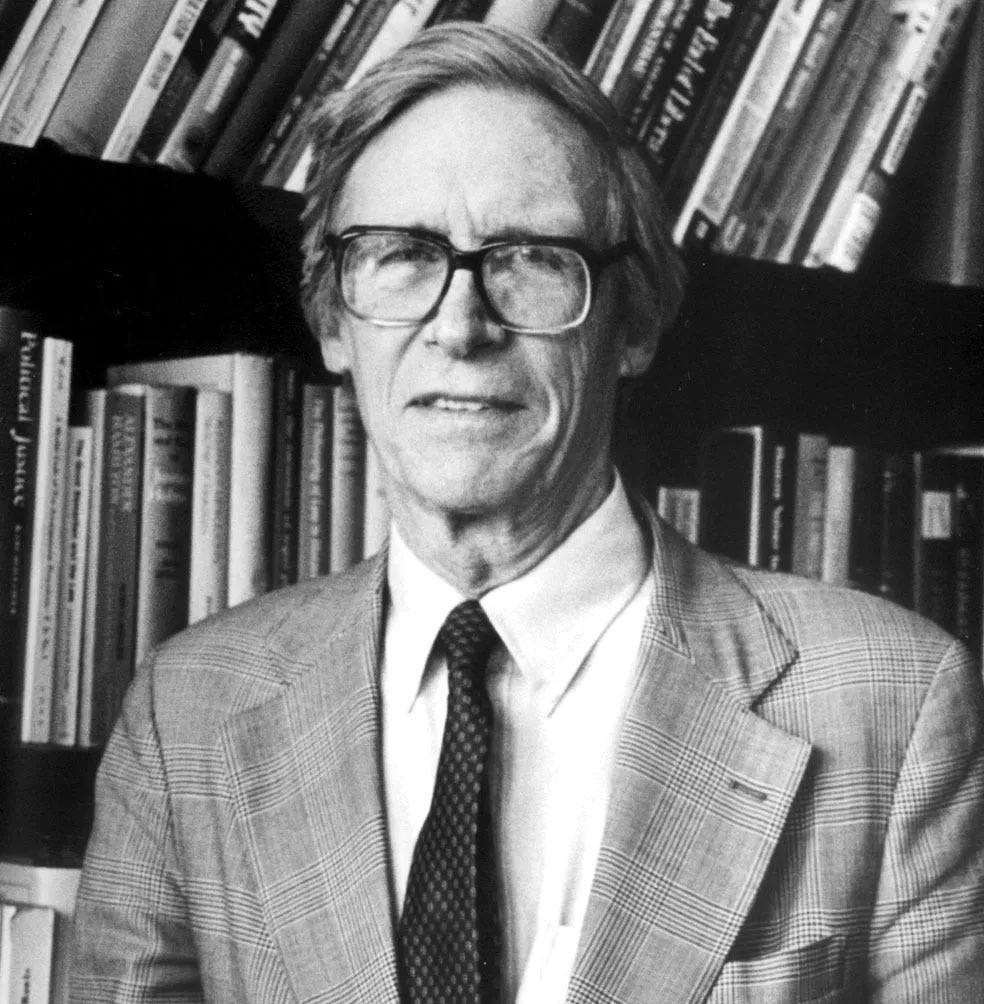
When John Rawls was a boy in Baltimore, he caught diphtheria. His younger brother Bobby caught it from him and died. The next year, John came down with pneumonia. His brother Tommy caught it and died too.
Rawls survived. His brothers didn’t. The difference had nothing to do with merit. It was luck. Who got sick first, who had a stronger immune system, who happened to be standing nearby.
Rawls grew up, fought in the Pacific, walked through the ruins of Hiroshima, and spent the rest of his life thinking about the role luck plays in who suffers. In 1971, as a philosopher at Harvard, he published A Theory of Justice, which asks one deceptively simple question.
Imagine you are designing the rules of a society, but you don’t know which seat you’ll get. You don’t know if you’ll be rich or poor, healthy or sick, a citizen or an immigrant, the person with the chainsaw or the person the chainsaw cuts.
Rawls called this the veil of ignorance. Behind it, he argued, rational people would choose rules that protect the worst-off because they might end up being the worst-off.
In other words, you don’t need to love your neighbor. You only need to acknowledge that you could have been born in your neighbor’s place.
Jordan failed the test by embracing economic pain while assuming her own safety net was secure. John failed when even his friends’ deportations couldn’t shake his approval of Trump. And Mike failed when he demanded a chainsaw for public protections, apparently certain he’d never feel the blade himself.
The bill comes due
A year later, the Times assembled another group of Trump voters. These Trump voters were disappointed that the president seemed preoccupied with everything except making their lives easier.
Disappointed. Not ashamed.
Polling backs up that sentiment. In August, Navigator Research found that only 18 percent of Trump voters regretted their vote. Fifty-eight percent are still “very confident” in their choice.
Flip that number over. Eighty-two percent looked at a war with Iran, gas and grocery prices climbing, health premiums projected to double, and millions of people forced into food insecurity through lost SNAP benefits and said…yeah, no regrets. Those same 82% of MAGAmuffins see nothing wrong with a president who lifted sanctions on Russian diesel three weeks before the midterms so Americans could fill their tanks a little cheaper while Ukrainians pay the difference in blood.
It’s not their blood, so screw em.
You might have noticed that when Trump voters do show their disapproval, it’s never about the people Trump hurt. It is always focused on themselves.
They may complain about the Iranian war driving up the price of everything, but they never mention the 168 schoolgirls the U.S. murdered in Minab, Iran.
They worry about healthcare costs, but are oblivious to the USAID cuts that will cause 14 million additional deaths worldwide by 2030.
And here’s a particularly revealing comparison. 63 percent of regretful Trump voters were angered that Flock’s license-plate surveillance cameras trampled on their constitutional rights, yet only 29 percent cited immigration enforcement going too far among their reasons for regretting Trump. Meanwhile, the government had already shipped 238 Venezuelans to El Salvador’s notorious CECOT prison without due process.
Apparently, constitutional protections become considerably more interesting when the government starts photographing your license plate.
George Washington asked Americans to sacrifice their individual advantages for the community. Trump voters were prepared for sacrifices. They just assumed others would bear them.
The people who didn’t vote for a convicted felon and sleezebag found liable for rape have every right to be angry at the voters who threw democracy away with both hands. I will continue to be mad because I am Italian and we don’t forgive unless there’s a funeral.
However, maybe — and this is a big maybe — we can find forgiveness in our chipped hearts if we remember that some Trump voters are a result of a broken social contract. FDR understood that a republic that expects its citizens to defend strangers’ rights has to ask whether it has given those citizens a fair chance to live securely. We have been failing that test for a while.
At the same time, citizens who demand constitutional and social protections for themselves can’t treat those same protections as optional for everyone else.
We broke this bargain at both ends.
So when you vote in three weeks, who are you voting for?
The honest answer is both: yourself and the community. That was always the bargain. Washington understood what citizens owe their republic. Roosevelt understood what the republic owes its citizens. Madison built safeguards against the dangers of selfish factions. Rawls gave us a moral test we can run at the ballot box.
The Latin root of republic is res publica — the public thing.
It only works if we remember there’s a public in it.

Carlyn Beccia is an award-winning author and illustrator of 13 books. The Grim Historian is a reader-supported publication. To receive new posts and support my work, consider becoming a free or paid subscriber.
Another piercing analysis, revealing historical truths which, from the outset, threatened the Republic (and of which most Muricans know nothing).
Trouble is that unrestrained FACTIONALISM has always undercut the promise of America.
Now hyperpowered by vampire Capitalism, it also threatens the planet!
"I will continue to be mad because I am Italian and we don’t forgive unless there’s a funeral."
🇮🇹👏🤣
🏴☠️