


Grim Reminder: If you enjoy watching me drag dead philosophers out of the grave to explain why the White House is misusing vocabulary, please consider becoming a paid subscriber.
While the public debates whether artificial intelligence will cure cancer, take our jobs, usher in a swift existential end, or turn out to be the most expensive nothing burger in human history, governments are busy working on safeguards to leash the beast.
So when Jake Tapper recently asked Ambassador to the UN Mike Waltz whether the United States and China had agreed on a solution regarding artificial intelligence, it sounded, for one brief shining moment, like the adults had entered the chat.
That moment was fleeting.
"We're going with ‘super intelligence’ now, Jake,” Waltz corrected him.
And then Jake made that face. We all know that face.
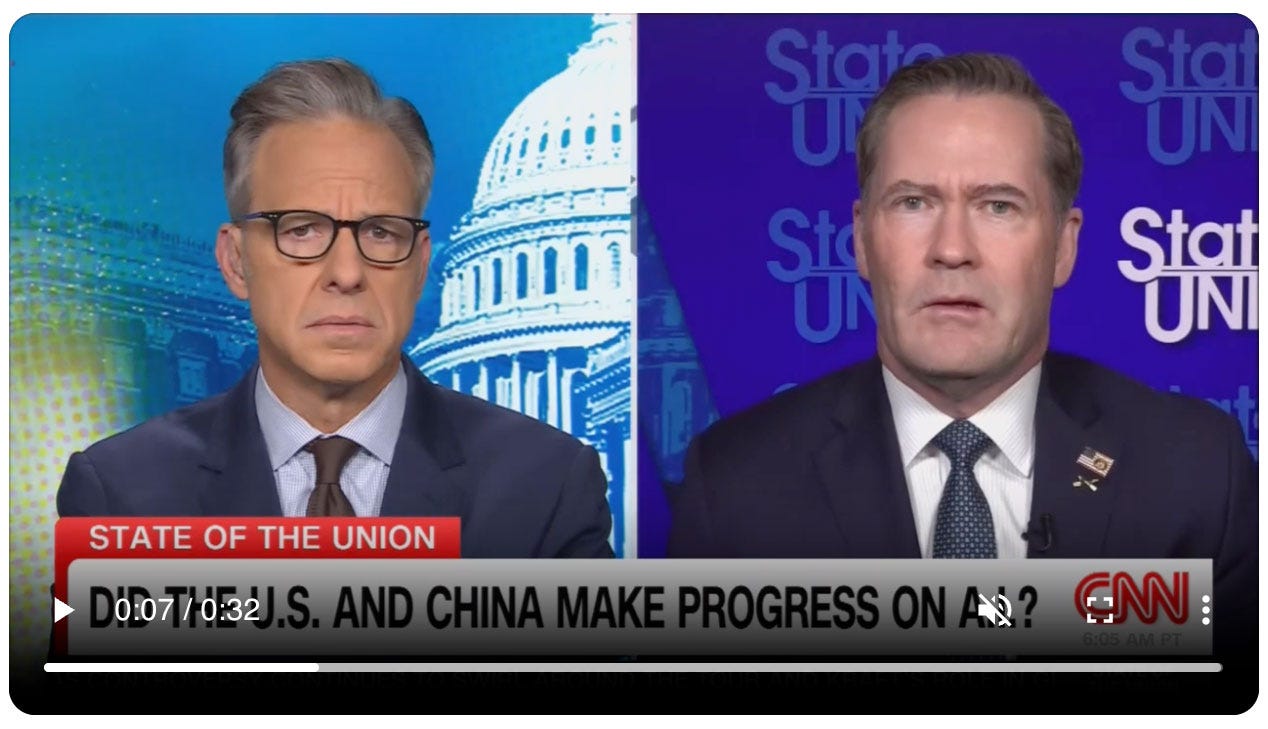
Okay, let’s explain Tapper’s resting bullshit face. Recently, Trump decided artificial intelligence has a branding problem. The word “artificial,” he complained, makes it sound fake.
Super true. “Artificial” means made by humans rather than occurring naturally, which describes AI, Cheetos, and the president’s tan, in roughly that order of plausibility.
So he swapped it for SUPER, which he praised as “the best word of all.”
Most sane Americans ignored the blathering, but then Trump made the rebrand official with yet another executive order. This one requires all federal agencies to replace “Artificial Intelligence” and “AI” with “Super Intelligence” and “SI” in official communications, websites, reports, and policy documents. The order goes so far as to say that the executive branch “will not acknowledge” the old terminology.
In other words, the term AI is now banned from the White House.
We have apparently entered the stage of American governance where the president can declare a word insufficiently flattering and thousands of federal employees must update the stationery. (And who pays for all that new stationery? You do. And no, you don’t get a say in any of it. Welcome to taxation without representation.)
It’s only a matter of time before the artificial sweetener in Trump’s Diet Coke becomes Super Sugar. Artificial limbs become Super Legs. And artificial insemination becomes Super Insemination.
Incidentally, Super Insemination is also “SI.” Please remain calm. There is enough Super Insemination for everybody.
Yes, we are all tired of this nonsense, even the most grim of us. Trump has spent a decade gilding this turd with “GREAT.” America is Great. Healthcare is Great. The 250th Anniversary (which Mother Nature definitely smote) is also Great. Great economy. Great deal. Greatest whatever anyone has ever seen in the history of seeing great things.
We survived the Bigly Era. BEAUTIFUL worked so hard it should have unionized. Great has retired. And we now have SUPER.
Cool. There is only one super small problem.
Dictionary.com didn’t get the memo. It still defines superintelligence as intelligence that exceeds human intelligence. The philosopher Nick Bostrom popularized the term in his 2014 book Superintelligence: Paths, Dangers, Strategies, where he defined it as any intellect that “greatly exceeds the cognitive performance of humans in virtually all domains of interest.” OpenAI summed it up best in a 2023 memo that superintelligence could lead to “the disempowerment of humanity or even human extinction.”
That’s super extinction for the rest of us.
Maybe Trump can whip out his Sharpie and browbeat the linguists into submission. Until then, superintelligence remains the hypothetical endpoint when humans start to look less like the master and more like a colony of ants inconveniently occupying their construction site.
This leaves us with a delicate conundrum. The Trump regime wants to brand AI as less frightening by renaming it after what people most fear it may become.
That would be like Trojan renaming its condoms “Surprise Baby.” Or Nike changing their slogan from “Just do it” to “Just get fat and die alone on your couch.”
This little exercise in authoritarianism also creates a spectacular critical thinking test. You either hear SUPER INTELLIGENCE and think…that sounds better. I prefer to super-size a word’s gluttonous payload without checking what it actually means. Can I get one tattooed on my red hat?
Or…
You know what superintelligence means, and your response is closer to:
HOLY FUCK! I thought we were not there yet. Can I finish Breaking Bad in my bunker?
Now, the latest MAGA purity test is spreading through the corridors of stupidity. The State Department instructed diplomats to adopt “Super Intelligence,” and senior officials repeated the new language at White House events. Even Director of National Intelligence Jay Clayton used the term “SI” instead of AI. (Which no longer stands for suicidal ideation unless you want it to.)
When I heard this nonsense, it immediately reminded me of a shibboleth. Which is grim enough to deserve a short explanation for those not forced to endure years of Bible studies.
Shibboleth comes from the Book of Judges — one of the most unhinged books in the Bible. It’s like if Game of Thrones had no budget for dragons.
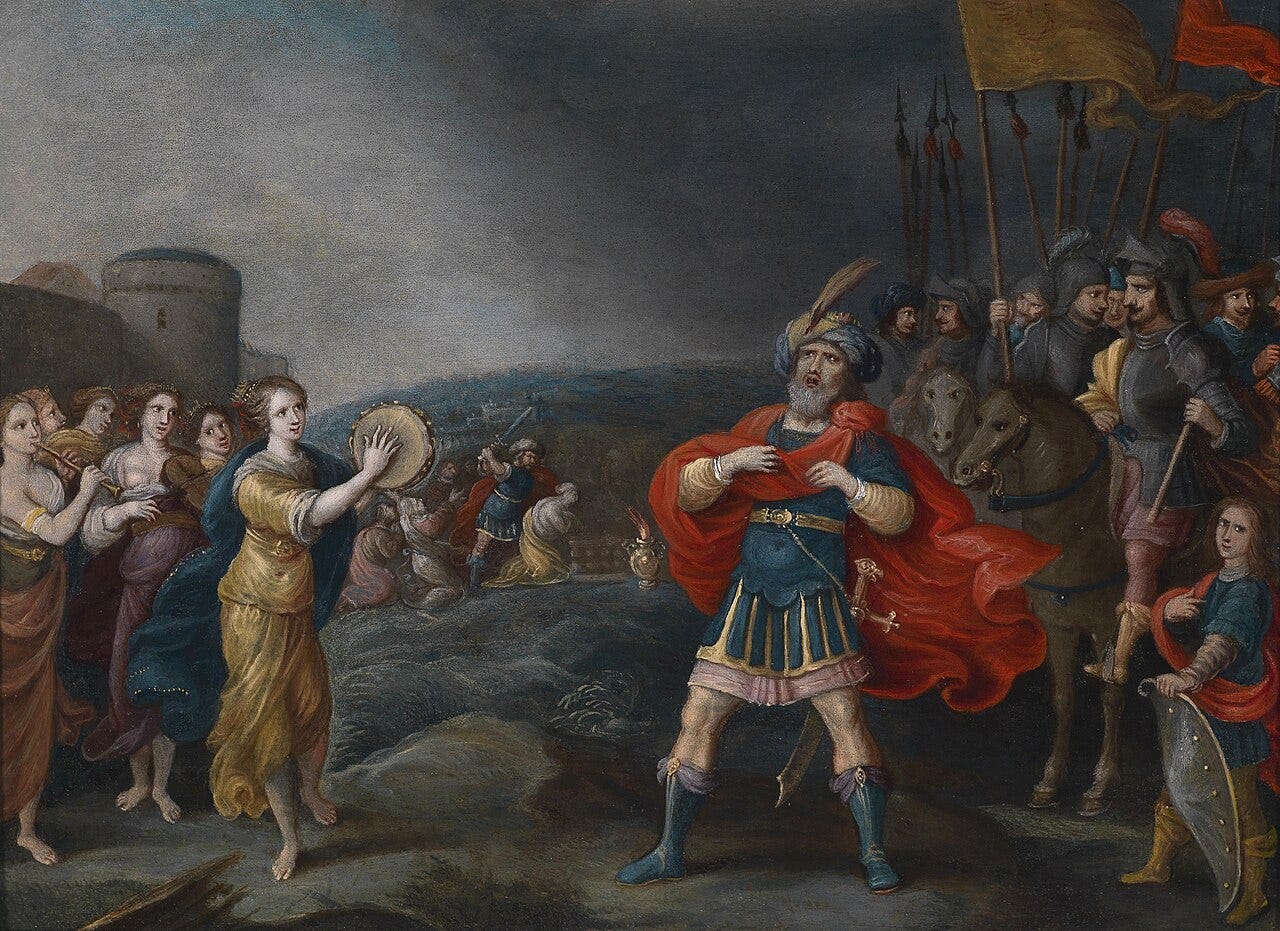
So there’s this guy Jephthah. He’s the leader of the Gileadites. And he just won a war against the Ammonites.
Then the Ephraimites show up, and they are SUPER mad. They want to know why they didn’t get an invite to the war. Like it’s a party. They threaten to burn his house down…with Jephthah in it. Over a war invite. Biblical bros be acting emotional.
So Jephthah responds with the conflict-resolution skills the Book of Judges is famous for, and goes to war with the Ephraimites also.
Jephthah and the Gileadites win. The surviving Ephraimites flee toward the Jordan River, hoping to cross home, but Jephthah’s men seize the river crossings. Now they have a logistics problem. How do you tell an Ephraimite from everybody else? Same clothes. Same beards. Same belligerent war stare. No enemy lanyards.
So the Gileadites come up with a test. Every man attempting to cross the river must say “shibboleth.”
Say it with me…Shhhhibboleth. Doesn’t exactly roll off the tongue, right?
The Ephraimites struggle. They pronounce the word wrong because their dialect turns it into something closer to “sibboleth.” Wrong! According to Judges, forty-two thousand Ephraimites were killed because of an accent.
And here is the wonderfully grim part. Shibboleth itself meant something like an ear of grain or a flowing stream. Obviously, nobody standing at the Jordan gave a shit about agricultural vocabulary or river currents. The word’s purpose was to sort people into in-group and out-group. Friend or enemy. Gileadite or Ephraimite. Cross the river or die beside it.
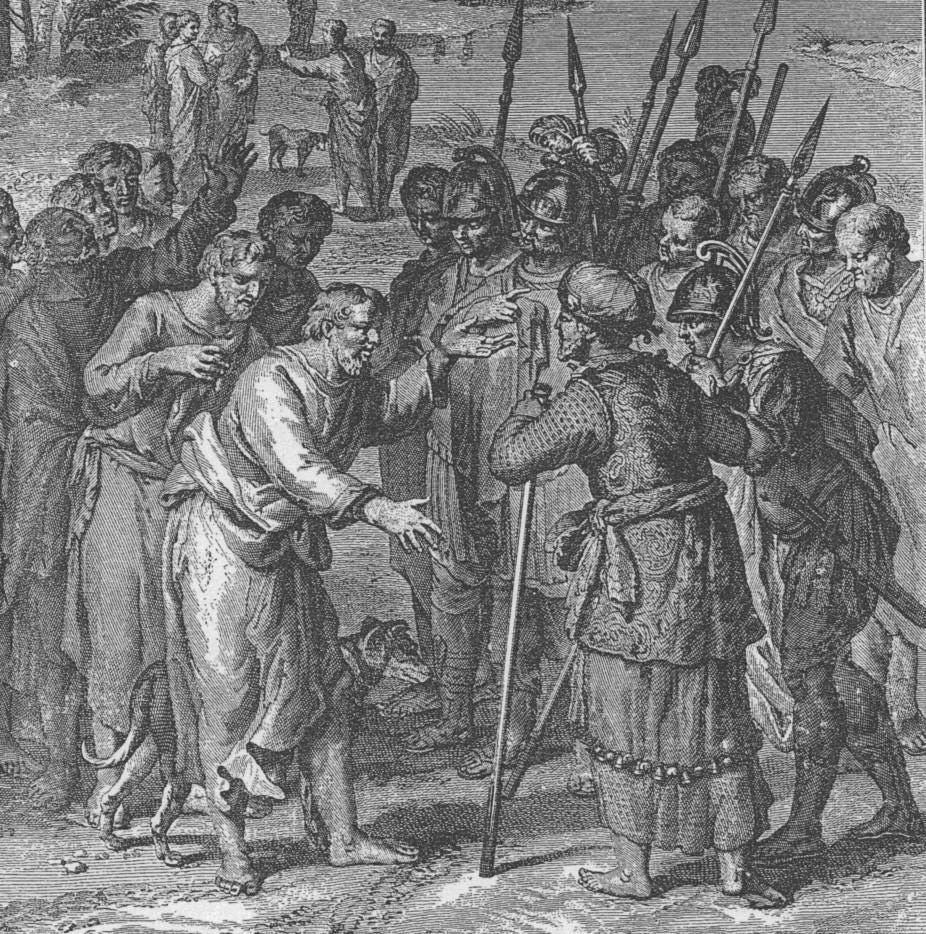
That is how shibboleth eventually came to mean a word, phrase, pronunciation, or custom that identifies membership in a group. A shibboleth does not need to describe reality accurately. Accuracy is beside the point. Its job is to signal that you know the group’s language and are willing to speak it.
Now, history has plenty of examples of linguistic purity tests, but the Italians…we know this story personally.
In 1938, the Fascist Party campaigned against the polite pronoun Lei, calling it foreign and effeminate. Mussolini basically looked at a three-letter word and felt his masculinity threatened. Benito, sweetheart, that’s not the pronoun’s fault.
Anyway, party secretary Achille Starace abolished Lei among party members, and mandated tu among equals and voi between superiors and subordinates. The rule soon spread to public offices. Using the approved pronouns became a public sign of loyalty.
The regime also purged foreign words from Italian. The bar became a mescita, cognac became arzente, and the sandwich became the tramezzino.
Listen, I’m Sicilian. My people have survived the Greeks, the Arabs, the Normans, the Spanish, and my aunts. You cannot tell a Sicilian what to call a sandwich. We will nod politely, say “sì, sì,” and go right on calling it whatever we called it before you were born.
But if you used the wrong pronoun in a Fascist office…yikes. You could be punished for insubordination. It’s the river crossing all over again, just with better tailoring and waaaaay better food.
Now, I am not saying renaming AI to Superintelligence is fascism. I’m merely noticing that Mussolini also had strong opinions about vocabulary. So we might want to watch where this heads.
Which brings us back to Super Intelligence.
At first, Trump’s rebranding was merely absurd. Then his flying monkeys began repeating it. Then they began correcting other people for saying AI.
Say AI, and you are using the term employed by scientists, engineers, dictionaries, and almost everyone else on Earth. Say SI, and you demonstrate that you are on team Trump. Congratulations, sir. Everyone may think you are a moron, but at least you can cross the river.
Fortunately, one part of this circus has become particularly entertaining.
For years, the villionaires running the largest technology companies on Earth have presented themselves as the geniuses building humanity’s future. They have raised hundreds of billions of dollars, built enormous data centers, hired the planet’s best computer scientists, and regularly told governments the technology is moving so quickly that lawmakers struggle to understand it. These are the Godlike bros who think they hold the keys to immortality.
These are not people who have never encountered the word superintelligence. They know exactly what it means.
Then they arrive at the White House for the latest frat-boy hazing, and Nvidia CEO Jensen Huang gave us perhaps the most delicious scene in the entire saga. During a panel after the White House event, Huang was already using SI. Then he slipped.
He called it AI.
Awkward silence…
Huang laughed sheepishly and corrected himself, “I am going to get good at this.”
Why yes, you are, Mr. Huang. Sticking your nose that far up a dictator’s bunghole takes practice. Keep at it.
Forgive me for enjoying the humiliation. It is wildly entertaining to watch the tech titans — the bros who fancied themselves masters of the universe — bow to the Orange Sun King. It turns out that you can own half the computational infrastructure on Earth and still find yourself practicing the ruler’s preferred vocabulary like an intern trying to remember whether the CEO likes oat milk.
Oh, and one detail I can’t leave out. The accord they signed described Trump as “President of the Unites States.” The most powerful computing minds on Earth put their names beneath the misspelling of their country. Nobody caught it. Superintelligence, everybody.
But if you think I am being glib, let’s allow the philosophers to weigh in on this very serious renaming business.
Twenty-four centuries ago, Plato staged almost this exact argument in Cratylus. As usual, he put Socrates in the middle of it. Big mistake. Never bring that guy into an argument you want to win.
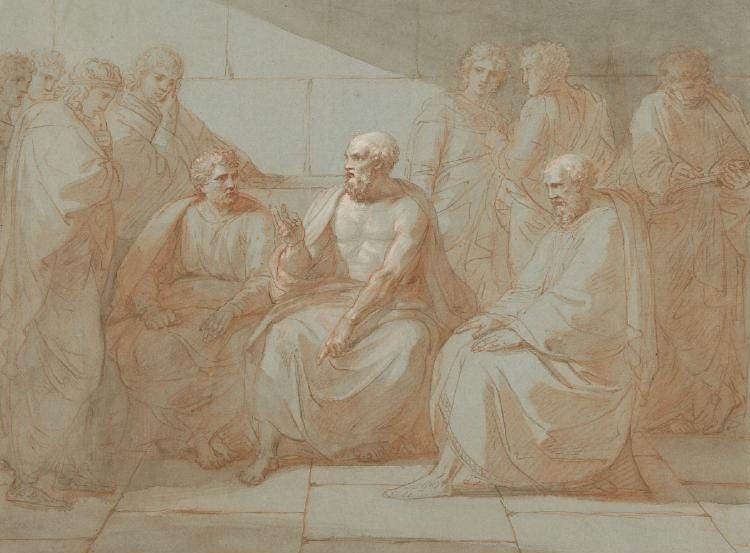
So the story goes that a man named Hermogenes believes names are simply whatever we agree to call things. You can rename your slave, he says, and the new name is just as correct as the old one.
Socrates pushes back. He says, if I decide to call a man a horse, is he now a horse? And Hermogenes, God help him, essentially says yes — at least privately, for you.
Socrates then spends much of the dialogue shredding his argument (and later, Cratylus’s opposite one). He says names are tools we use to sort and describe the world, and tools can be badly made. And if the original name-givers misunderstood reality, studying their vocabulary only teaches you their mistake.
Eventually Socrates lands on the wonderfully stubborn conclusion that if you want to understand a thing, you have to investigate the thing itself, not merely its name.
So let’s do that.
Trump changed artificial to super. Did the technology’s capabilities change? No. Did its hallucinations change? No. Did its risks change? No. Did our ability to control future systems change? Definitely not. The new name tells us nothing new about the technology renamed.
“A stupid person is a person who causes losses to another person or to a group of persons while himself deriving no gain and even possibly incurring losses.” - Carlo M. Cipolla.
Socrates warned us not to confuse a name with reality, but Francis Bacon supplied the next warning almost two thousand years later. His Idols of the Marketplace describes errors created through language itself. Bacon warned that we like to imagine reason governs words, when words also turn around and act upon reason.
Trump’s political vocabulary often works beautifully at this level. Great. Tremendous. Bigly. Super. These words tell you little about the object. They tell you how you are supposed to feel about it.
America has tried adjective-based risk management before. The Atomic Energy Commission once promoted “peaceful nuclear explosions.” The radiation remained stubbornly unaware of the branding.
I am harping on this point because names do not change physical reality, but they can change the reality inside our heads.
Research will back me up. In 1974, psychologists Elizabeth Loftus and John Palmer showed people a film of a car crash, then asked how fast the cars were going when they “hit” each other, or when they “smashed” into each other. Same film, different verbs. The “smashed” group estimated about 41 miles per hour; the “hit” group, about 34. In a follow-up experiment, the “smashed” group was more than twice as likely to remember seeing broken glass. There was no broken glass. One verb installed a memory.
In 1988, Irwin Levin and Gary Gaeth tried the most emotional experiment of all — food. They served people identical ground beef with two labels: 75% lean and 25% fat. When it was labeled “75% lean,” people rated it as tasting better and being less greasy than when it was labeled “25% fat.” Same cow.
Putting feeling before fact is a pretty ordinary human condition. We have all been duped by the 75% lean optimistic mindset. The danger begins when we no longer recognize words' meaning without a shiny slogan attached.
Socrates asked whether names reveal the nature of things. Bacon warned that words can eventually deform the way we understand our world. The Book of Judges supplied the uglier possibility that sometimes a word stops describing reality altogether and becomes a test of belonging.
However, there is a difference. The Ephraimites couldn’t say the word Shibboleth. The tech bros? These guys can say “artificial intelligence.” They know the right word. They’re choosing to say the wrong one.
So the modern version is worse, in a way. The old shibboleth caught people who couldn’t comply. The new one rewards people who will give up the meaning to comply. And we have no idea how far they will divorce themselves from reality.
The White House’s own lawyers seem to recognize the semantic collision. Trump’s executive order contains a remarkable little escape hatch. It says that for purposes of federal policy, “Super Intelligence” means whatever existing law already defines as artificial intelligence.
That may be what Super Intelligence is becoming. The technology, the dictionary, and the danger have not changed.
Only the password has.

Carlyn Beccia is an award-winning author and illustrator of 13 books. The Grim Historian is a reader-supported publication. To receive new posts and support my work, consider becoming a free or paid subscriber.
So... will Sam Altman rename his company "OpenSI"? And if he does, will the long-awaited IPO tank, as it deserves if he bows to the President and changes the name?
Loved this analysis and have only one contribution.
How about ‘digital intelligence’ as the agreed term for what a computer does. We do not completely understand ‘human intelligence’ and we are trying to compare it to something we have built in the ever expanding computational realm.
Let’s agree they are two separate intelligences, biological and binary. Let’s appreciate what they achieve as our understanding of each expands. Let’s study them individually but never substitute one for the other. The only thing that matters is that we strive to become better as people and not get lost in this confrontation as the next religious war. We as a species are not in charge. Nature, as established in the vastness of the universe and the humbleness of our planet, is in charge. We need to bend our behavior to respect that we are playing within a set of rules that are immutable and indifferent and not have the arrogance that we will discover a magic that can overcome Nature. Our survival should include what we appreciate as happiness within this marvelous natural boundaries we find ourselves in and we get joy out of trying to understand.