


Grim Reminder: A Grim Historian is a reader-supported newsletter and depends on your 5$ donations to keep the most depressing politics and history in your inbox. Please consider becoming a paid subscriber or sharing with someone who loves misery.
In Part One of our stroll through oil history, Venezuela spent a century learning an irritating lesson that finding petroleum is the easy part. The trouble starts when humans gather around it.
Now Trump has announced the “biggest oil deal in world history,” which is reassuring only if you skipped Part One.
The new arrangement gives the United States access to roughly one-fifth of Venezuela’s oil reserves through 17 fields. Standing rather prominently beside this newest gate is Venezuelan businessman Alejandro Betancourt — a Chávez-era billionaire who seems to have mastered the most durable skill in an oil economy.
Betancourt is useful to whoever currently has the key.
But before we get to the strange question of why oil makes some countries rich while turning others into cautionary tales, we should meet the man at the gate.
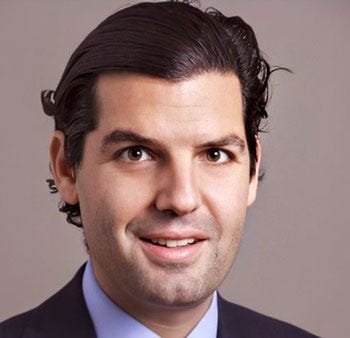

Betancourt belongs to Venezuela’s famous class of bolichicos — young businessmen who became spectacularly wealthy during the Chávez years.
During this time, Venezuela needed power plants. So his company, Derwick Associates, stepped in and won roughly $2 billion in state contracts, including some awarded without competitive bidding.
Unfortunately, Derwick had very little experience building power plants. This did not appear to be a dealbreaker. Government records later showed that many of the plants operated far below capacity or not at all. (Betancourt and Derwick have denied wrongdoing. They claim the facilities were completed and blamed later failures on state mismanagement.)
Then his résumé acquired a legal appendix.
By 2019, Betancourt was under federal investigation in connection with an alleged scheme involving more than $1 billion misappropriated from PDVSA and laundered through Miami real estate and overseas accounts. Investigators identified Betancourt as an unnamed, unindicted co-conspirator. They never charged him.
Spain and Switzerland also opened money-laundering investigations. In March 2026, a Spanish judge shelved that case. Prosecutors appealed, and it was reopened in June. The Swiss criminal investigation remains open. Betancourt has denied any wrongdoing.
So let’s ask the obvious question. How did a Chávez-era billionaire repeatedly investigated over alleged money laundering wind up holding one of the largest keys to Trump’s new oil gate?
In 2012, Betancourt entered a partnership with PDVSA to operate mature fields in western Venezuela. Those fields eventually became core production for NABEP, which Betancourt co-founded in 2024.
Before Maduro’s capture, Betancourt also supplied information that helped the United States enforce its blockade of sanctioned Venezuelan tankers, facilitated contacts with Delcy Rodríguez, and afterward helped broker oil agreements between Caracas and Washington.
In other words, Betancourt had connections to both sides of the gate.
And Washington did not merely choose Betancourt’s company as a partner. Under the agreement, NABEP will receive a 100-year lease covering 17 oil fields. The Pentagon’s Office of Strategic Capital takes a 35 percent stake in NABEP, while the State Department gets the right to buy 20 percent of its oil at cost and preferential access to the remaining output.
There was no competitive bidding, and negotiations remained secret until shortly before the announcement. Venezuela’s ruling-party-dominated National Assembly has since backed the agreement, but lawyers and petroleum experts continue to question its legality, transparency, implementation and durability.
Don Trumperoni has also suggested that his regime may decide which companies deserve access. When Exxon CEO Darren Woods publicly called Venezuela “uninvestable,” Trump complained that Exxon was “playing too cute” and suggested he might keep the company out. By August 31, Trump announced that Exxon was “going in.” (Exxon has been rather less enthusiastic and has not confirmed its plans.)
Again, consider the sales pitch.
Please invest tens of billions of dollars because political interference is over. Also, I may punish your company for expressing concern about political interference.
Somewhere an Exxon risk analyst quietly added another slide.
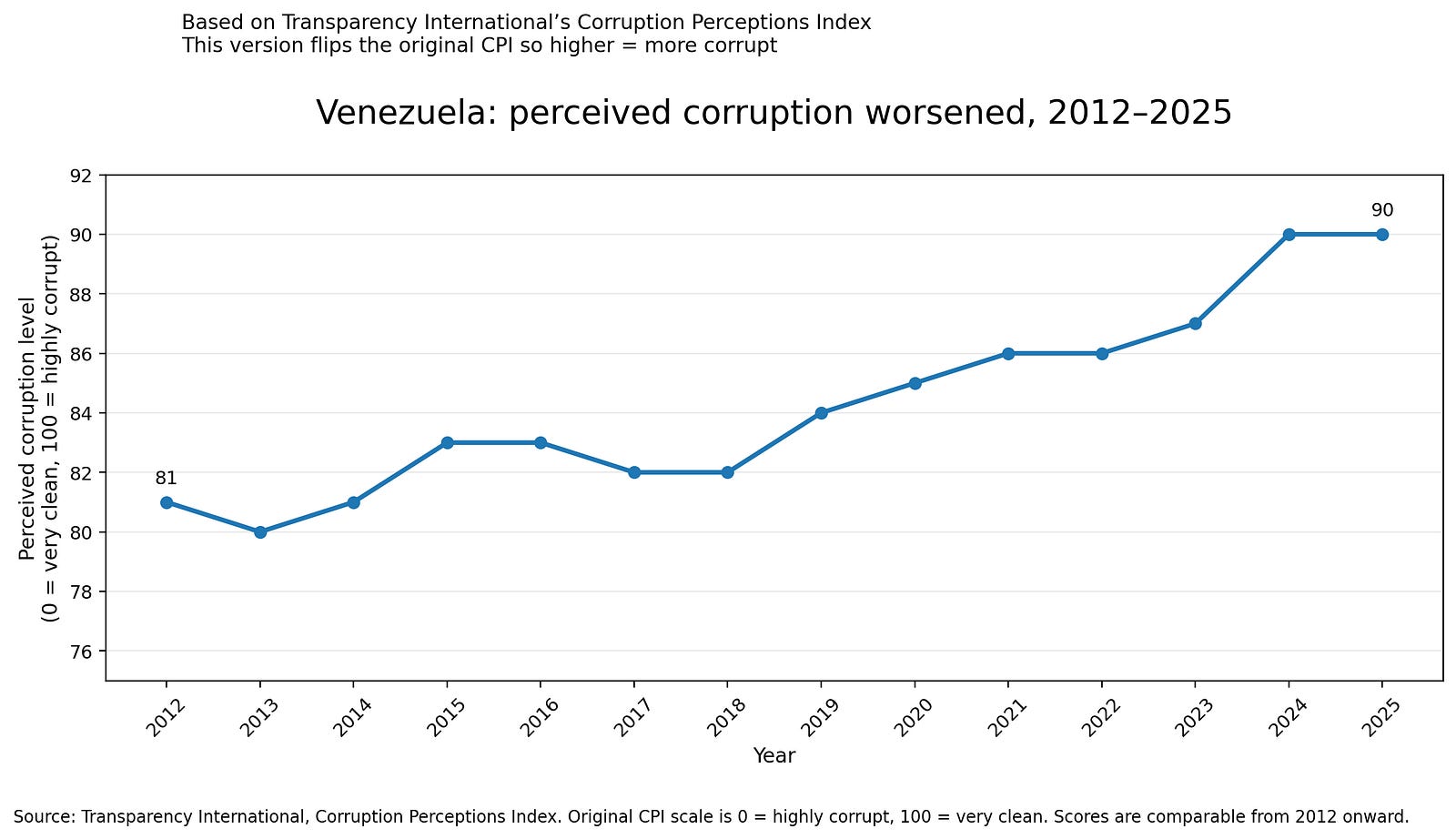
And now…your gas prices
This brings us back to the reason Americans should care, even if they have never spent a single Sunday watching Hugo Chávez sing Venezuelan folk songs.
Trump’s promise depends on enormous private investment. Private petroleum investment runs on a timetable completely indifferent to midterm elections. Bringing Venezuelan oil to market at that scale requires evaluating fields, drilling wells, rebuilding pipelines, securing diluent, restoring facilities, negotiating debt, moving extra-heavy crude, finding specialized refining capacity, and then operating long enough to recover tens of billions of dollars.
That means trusting Venezuela years from now. Perhaps longer.
It also means trusting the United States. Trump can promise Exxon access to Venezuelan oil, but he cannot promise Exxon the next American president will follow the same plan. Obviously, a future U.S. administration could regard Trump’s structure as excessively extractive or neo-colonial and attempt to renegotiate the American role.
A future Venezuelan government could also challenge agreements made under Delcy Rodríguez.
A nationalist movement could demand that the petroleum be returned to greater state control.
Another authoritarian could simply change the rules.
None of these things must happen. That is not how investment risk works. They merely can happen. And oil companies put a price on can.
They demand higher returns, stronger guarantees, and better contractual protections, or they put the money somewhere else. This risk is why Venezuela’s history is not some amusing sidebar to Trump’s oil deal.
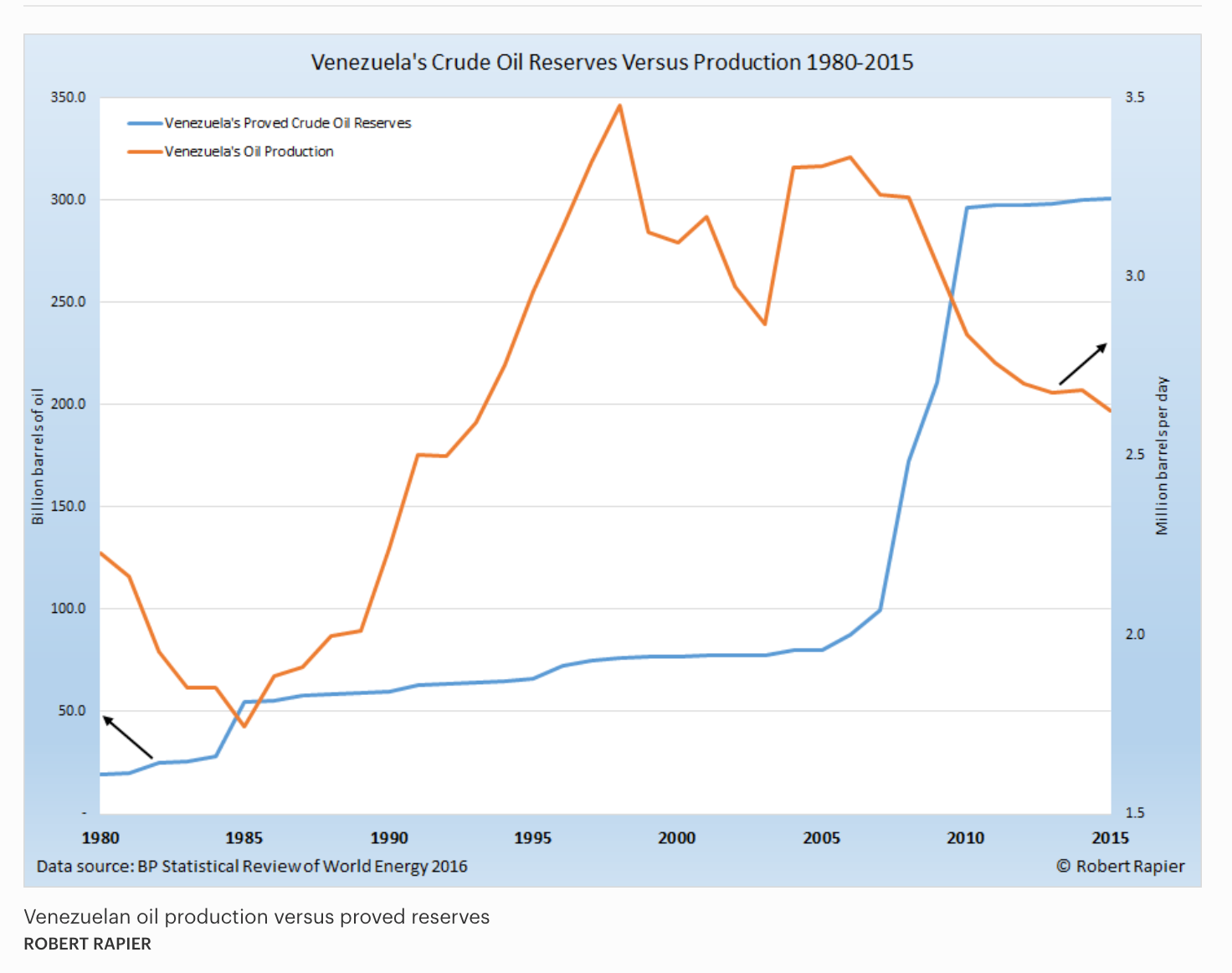
History is part of the cost of every Venezuelan barrel
None of this means countries are doomed because they discover petroleum. The resource curse is not destiny.
Saudi Arabia, Venezuela and Norway provide three remarkably different case studies to the same question:
What do you do when geology hands the state a giant treasure chest?
Venezuela let the treasure chest become the center of political life. The democratic parties distributed it. Chávez promised to reclaim it for the people. Maduro inherited it. Cronies learned to feed from it. Every political struggle became, at least partly, a struggle over who controlled the oil gate.
Saudi Arabia has diagnosed the economic problem much more clearly.
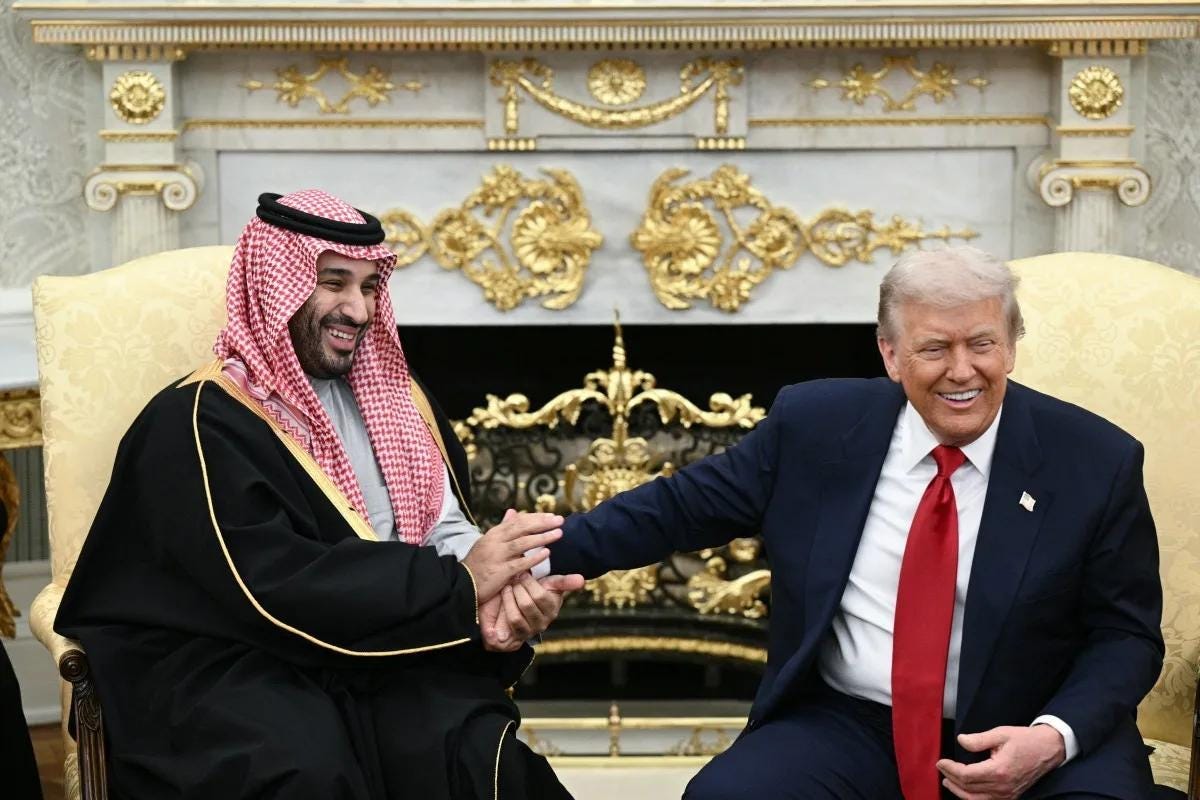
Mohammed bin Salman (MBS) knows petroleum cannot finance the kingdom forever. His Vision 2030 is therefore using today’s oil wealth to purchase tomorrow’s economy — tourism, logistics, manufacturing, technology, entertainment, finance and enormous pools of global investment. (Since Trump decided to blow up the Middle East, Saudi tourism is down 5%-6%. Apparently, bombs over your head ruin the sightseeing.)
Aramco itself has sold small stakes to public investors. The Saudi state has also transferred portions of Aramco and other state assets into the Public Investment Fund, which invests that capital across industries at home and abroad. This is smart diversification, but it does not solve the political problem.
MBS remains the crown prince of an absolute monarchy and directs much of this wealth. Meanwhile, Saudi Arabia has liberalized parts of social life while maintaining concentrated political control. For example, Saudi Arabia lifted its ban on women driving and pushed substantially more women into the workforce.
The modernization is real. But so is the monarchy.
Of course, those two things can serve each other nicely. A diversified Saudi economy needs more workers, more consumers, more industries, and more foreign investment. Social reform can make the kingdom wealthier without making the royal family less royal.
Saudi Arabia diversifies the treasure and keeps the gatekeeper. For an authoritarian, that is a perfect design. It’s also partly why Trump and his family get giddy around MBS.
Then there is Norway.
Norway also discovered a ridiculous amount of petroleum and reached a different conclusion.
Perhaps nobody should get to spend all this money all at once.
Its petroleum revenues feed the Government Pension Fund Global, which invests broadly outside Norway. Government withdrawals operate under fiscal rules and parliamentary oversight. This system is designed to prevent whoever happens to be in office from treating this year’s petroleum revenue like the winnings from a scratch ticket.
To be clear, Norway did not solve the resource curse by finding unusually incorruptible politicians. It solved much of it by building a system that assumes politicians should not be trusted with an unlocked treasure chest.
That’s the difference. Saudi Arabia diversified the assets. Norway diversified the assets and the power over them.
Make the oil boring
Trump approaches petroleum like a real-estate deal. There is an asset. Someone controls it. Someone wants it. Just put the right men in a room, make a deal, announce victory, and name it after yourself.
That works better when the building is already standing. (Or in the case of the East Wing of the White House, not standing.) A Venezuelan oil field may require years, or possibly decades.
And here is the funny part about all that waiting. Reuters currently puts Venezuelan production at about 1.25 million barrels a day; Reuters Open Interest estimates it could reach around 1.5 million within two years. That would add roughly 250,000 barrels to a global market consuming roughly 103 million every day. That increase can certainly put some downward pressure on oil prices, but it is not a torrent. It is roughly one-quarter of one percent of world demand.
Now let’s look at the long-term plan. By 2035, Rystad Energy, an independent energy-research firm, thinks Venezuela might reach 2.3 million barrels a day and above 3 million by 2050. That’s a meaningful addition to supply.
Splendid.
We only have to get through two presidential elections, several Congresses, approximately nine billion opportunities for somebody to change the deal, and a planet that may have other ideas about dirty energy.
Which brings us back to the sales pitch. Trump has promised Americans a torrent of cheap Venezuelan oil. Maybe he is right. Maybe production will increase. Maybe some companies will invest. Maybe Venezuela will finally begin rebuilding an industry sitting atop a geological fortune.
History does not forbid happy endings. But it does come with a blueprint and a raised eyebrow. And if this happy ending doesn’t raise your bullshit hackles, then you need to go back and read part one.
Cynicism aside, Venezuela has spent a century watching different characters approach the same treasure chest. Foreign corporations, dictators, democrats, revolutionary television stars in red berets, loyal understudies, cronies, and interim governments all arrived with the same promise — put the right people in charge of the oil, and prosperity will reach everyone.
Now, an American president is promising that his deal will finally make the oil behave.
Every one of them has had a plan.
Meanwhile, oil is always in less of a hurry than the salesman. It can remain underground much longer than any president can remain in office.

Carlyn Beccia is an award-winning author and illustrator of 13 books. The Grim Historian is a reader-supported publication. To receive new posts and support my work, consider becoming a free or paid subscriber.
excellent article, bringing one of the large cadre of "operators" under the spotlight.
I am amused by the raging debate I see on line about renewable energy vs. oil and gas. One would think based on the rhetoric that there is still a wide open debate about which source of energy is best for the world, or even the question does one source (renewables) actually even work? The truth is that renewables work (see Scandinavia in general, Norway in particular, the EU, and China internationally... domestically, see TX, OK, CA, Iowa, Illinois, etc.). the debate is a distraction put in play by the oil and gas "operators" trying to protect their gushing flow of profits. We know the following:
Oil is finite, and as we pull more out of the ground, each successive barrel becomes more costly and harder to extract. Barring some major technological breakthrough, this means in general, the cost of a barrel of oil will climb over time.
all oil is not created equal, either in quality or accessibility. Venezuelan oil is an example of oil that is of very marginal quality and extraordinarily difficult to get for geological and political reasons.
Most of the planet's oil is controlled by a few large corporations, countries, or individuals, creating monopolistic tendencies, risks of supply chain disruptions, and geo political blackmail.
Oil is absolutely necessary for certain markets... it remains the primary source for chemical feedstocks and lubricants. even some of the chemical feedstocks are finding biological routes that are commercially viable.
Sustainable energy can power homes, businesses, cars, trucks, and is making inroads into rail and even air. there are several routes to sustainable jet fuel that have been demonstrated to be economical, with support being pulled when trmp was elected.
Sunlight and wind are not generally controllable by a corporation or by any one individual, making this energy source less prone to blackmail and disruption.
Sustainable energy supply costs are coming down and will continue to come down into the future as the technology advances.
Oil has a very powerful PR force behind it, and there are powerful companies and individuals behind that PR push. truth and facts very seldom get in the way of the story of why oil and gas companies are good for Americans.
Individuals can install their own solar energy and small to mid sized farms can install their own wind energy. by the very nature of renewable energy, it represents a redistribution of wealth away from large corporations to smaller companies and to individuals. a EV owner with solar collectors at home is largely independent of Exxon Mobil.
Oil companies will not go bankrupt, will not go out of business, the US will not collapse, the world will not go dark as we wean ourselves from oil. Cigarette companies did not go out of business.
what will happen is a huge source of power, control, and corruption will be greatly reduced, right along with the pollution from burning oil for transportation and heat. a gallon of oil took millions of years to produce and cannot be regenerated. one can convert that gallon of oil into about 20 miles and a puff of exhaust from a car, or into a durable product. many of those durable products can be broken down and reused in some way shape or form. converting oil to distance in a car is not recoverable.. period.
when we tip the scales in favor of renewables, we will in effect create a change in the distribution of wealth in one area and we regain a bit of control for the future of our country and our individual lives.
the rich and powerful recognize all this and will fight like hell to prevent it.
Some other terms: "Betancourt had connections to both sides of the gate." = Fixer for transnational criminal syndicates
"Trump’s promise depends on enormous private investment." = Other People's Money;