

Mike Johnson Called Social Security an “Entitlement Program”
Republicans are preparing working-class Americans for the third rail. FDR and Francis Perkins warned this would happen.


Grim Reminder: A Grim Historian is a reader-supported newsletter and depends on your 5$ donations to keep the most depressing politics and history in your inbox. Please consider becoming a paid subscriber or sharing with someone who loves misery.
Speaker of the House Mike Johnson recently went on the Moon Griffon Show and explained the federal budget.
“The reason we’re in trouble,” Johnson warned, “is because over seventy-four percent of federal spending is on autopilot” — mandatory spending, that is your entitlement programs like Medicare, Medicaid, and things like Social Security.” These programs, he said, “have to be adjusted and fixed,” and Republicans “have a plan to do that next year.”
Republicans plan to fix Social Security? Well, that shouldn’t worry anyone.
It’s strange. For years, Republicans have insisted they would never touch Social Security. Then Johnson called it what Washington always calls it when it wants to bring out the knives: an “entitlement program.”
Technically, that word has a budget meaning. Politically, it has a smell.
Americans do not hear “entitlement” and think “statutory benefit earned through payroll contributions.” They hear welfare queen. They hear freeloader.
They hear someone taking something they did not earn.
Which is rich, because Social Security is one of the strongest pro-social programs humans have ever invented. You worked. The money came out of your paycheck. Every week, every month, every year, the federal government took its cut with the promise that when you got old, disabled, widowed, or orphaned, the system would be there.
Now Mike Johnson is looking at working-class Americans and asking— why are you welfare queens so entitled?
Let’s allow history to answer this one.
The white slave auctions of nineteenth-century New England
For two hundred years, New England towns were legally responsible for residents who could not support themselves. This sounds humane. Put a pin in that…
Once a year, often right after the annual town meeting, the better-off citizens adjourned to a tavern. An auctioneer called out the names of neighbors who had applied for public assistance and described each person’s body and capacities aloud — the way you’d describe a workhorse or a Heifer cow.
Then the bidding began.
This auction was a Dutch auction —an auction where the price starts high and is incrementally lowered until a buyer accepts it. In other words, the town wasn’t asking who would pay the most for the Widow Lampher. It was asking who would keep her alive for the least amount of money.
You bid thirty dollars a year. Your neighbor bids twenty-five. A snaggletoothed, grim-faced farmer in the back bids eighteen. Going once, going twice. The farmer wins. The town pays him eighteen dollars of public money, and for one year, he must feed, clothe, and house the Widow Lampher. In return, the winning bidder got the right to put his purchase to work, however he saw fit, unpaid, for the duration.
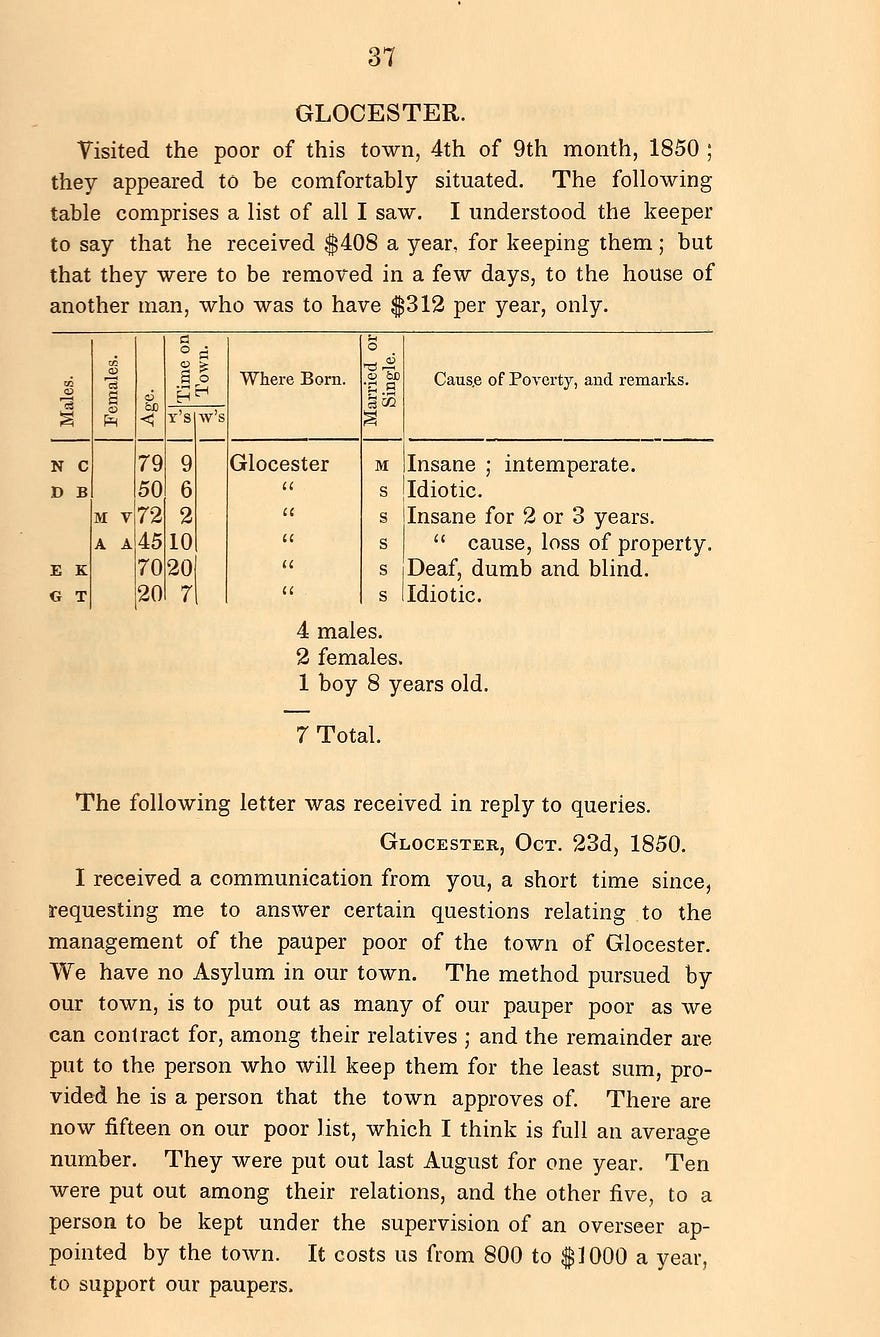
The reformer Thomas Hazard saw these human auctions plainly in 1851. Selling the poor to the lowest bidder was simply a “bounty for the most cruel and avaricious man in town.” And that included men whose definition of “work” could get creative.
Most of the auctioned slaves were widows and children. On October 18, 1786, the selectmen of Malden, Massachusetts, put a woman named Mary Degresha up for auction because she could not support herself; the low bidder collected six dollars a week for “taking proper care” of her.
In 1801, Christiana Lampher of West Greenwich, Rhode Island, was sold to a man named Ishmael Nichols, who agreed to feed, clothe, and house her — for one dollar a year.¹ One dollar. You do not need me to describe her meals.
In March 1825, a single mother and her four children went on the block together in Manchester, New Hampshire, and whether that family stayed together depended on how the lots fell, because families were routinely split at sale.²
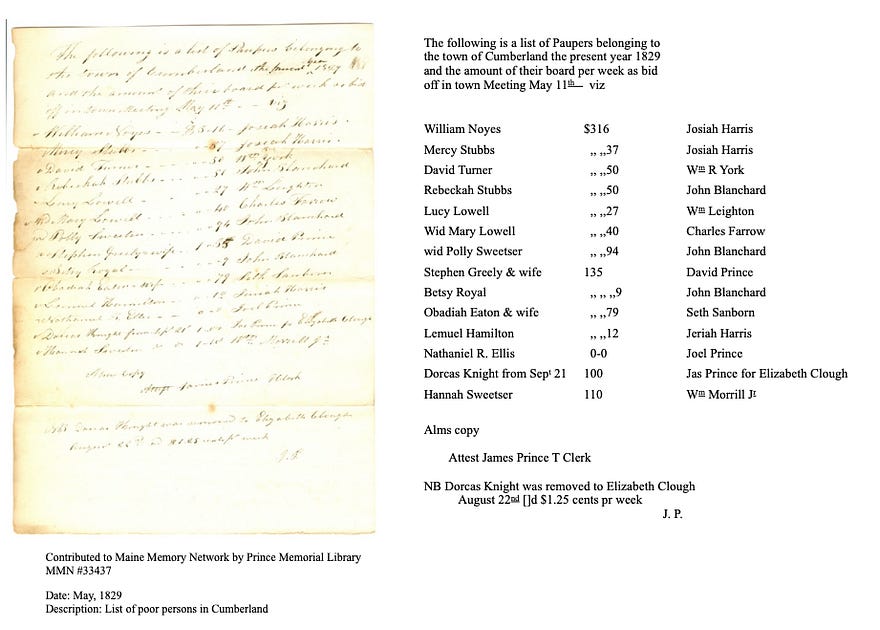
Read those names again. A town government transferred custody of a woman to a private buyer in return for her unpaid labor, without her consent, with no right of refusal. There is a word for that, and it is not “relief.” We prosecute it now under federal trafficking statutes. In 1801, it was the town budget.
And before anyone pictures some “woke” history — Black Americans didn’t even qualify for the auction. Relief required legal “settlement” in the town, and towns used a companion mechanism called “warning out” to expel poor Black residents before they could ever establish a claim.
The people on the block were Mike Johnson’s favorite people — white. White widows, white children, white men with broken backs. Contemporary critics called the system “white slavery” precisely because the victims looked like the bidders. So if you’re reading this and assuming the auction was for somebody else…yeah, think again. There has never been a version of this machine that stops at somebody else.
The Deserving Poor vs. the Undeserving Poor
The respectable people had worked out the theology in advance. The influential Quincy Report of 1821 sorted the destitute into two classes: the “impotent poor” — orphans, the disabled, the aged, the genuinely helpless — and the “able poor,” able-bodied unworthies presumed to be poor through drink or idleness. The first deserved pity. The second deserved discipline. The 1820s were inventing the welfare queen a hundred and sixty years before Reagan needed her.
The auction operated on a colder principle. Some towns ran two auctions at once. The able-bodied — Quincy’s suspect class — went to the highest bidder because their labor was worth buying; the town sold them like draft animals and pocketed the proceeds. The old, the disabled, and the children went to the lowest bidder, as liabilities to be warehoused for margin.
In other words, you were one broken hip from the auction block. After which, your neighbors calculated the cost of your remaining winters. Strong back: sold high, worked free. Broken back: sold low, fed thin.
To be clear, these auctions were not run by monsters. They were run by deacons, selectmen, taxpayers — ordinary Christians handed a legal mechanism that rewarded cruelty.
Over the Hill to the Poor-House
The auctions faded — not from conscience, but because towns found poorhouses cheaper, and made them deliberately wretched so the poor would rather starve invisibly at home. By 1872, the institution was so widespread that its anthem, “Over the Hill to the Poor-House,” became a national sensation, later a hit film. America’s retirement plan had a theme song, and it was a dirge.
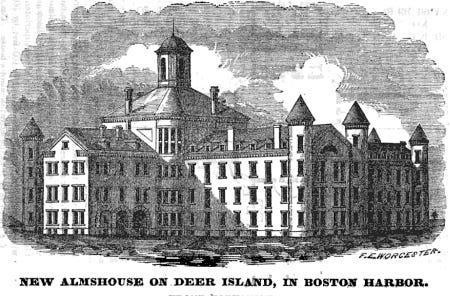
Well into the twentieth century, the poorhouse census was dominated by people guilty of nothing but outliving their savings — and in several states, entering one cost you the vote. Poverty didn’t just take your freedom. It took your citizenship.
Then the Depression tripled the clientele.
In 1933, a broke 66-year-old physician named Francis Townsend said he looked out his Long Beach window and saw three old women digging through garbage cans for their dinner. His solution was economically deranged — $200 a month for every American over 60, but with a catch. You had to spend the money within thirty days.
Obviously, the Townsend scheme would have devoured almost half the national income, but it didn’t matter. Within two years, roughly two million furious people had joined Townsend Clubs, thereby working Congress into a cold sweat. Huey Long was running his Share Our Wealth clubs in parallel and measuring the White House drapes.
This is the part the third-grade version leaves out: Social Security was not charity descending from a warm heart. It was rich people fearing a revolution. Old-age insurance has always been counterrevolutionary technology. Otto von Bismarck, an actual Prussian aristocrat, invented it in 1889 specifically to steal the socialists’ thunder.
FDR built Social Security in part because the alternative was the hungry mob.
The woman who knew where the bodies were
Social Security’s architect was Frances Perkins — the first female cabinet member. Perkins had witnessed the Triangle Shirtwaist Factory fire and watched workers leap from the ninth floor.
Her story has been told. Here’s the part that hasn’t. Perkins was terrified the Supreme Court would strangle the program in its crib. At a Washington tea party, she confessed the fear to Justice Harlan Fiske Stone — who leaned in and murmured the cheat code: the taxing power, my dear. You can do anything under the taxing power.


And so the first glimmers of a Social Security program were born, not as charity, but as a structured tax. It survived the Court 7–2.
Later, FDR billionaire-proofed it. He insisted on funding Social Security through payroll contributions over the objections of his own economists. He put the tax on the paycheck because he knew you were coming, Mr. Speaker. He knew that someday a man in an expensive suit would stand in front of a microphone and call the check a handout, and he wanted every worker in America to be able to say five words that end the argument: I paid in. It’s mine.
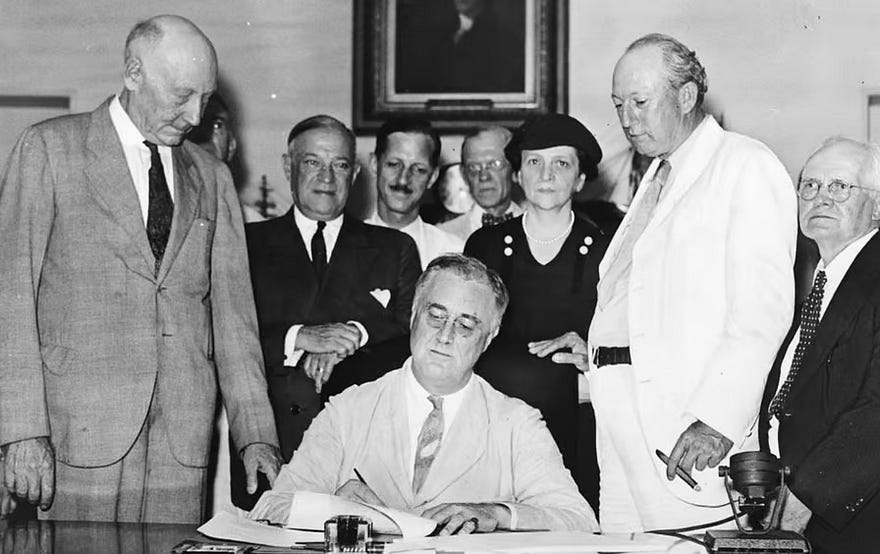
That is not autopilot spending. That is a debt — the most honored debt in American life, collected from every paycheck of every shift you ever worked, on the promise that this country would never again run its old age like a poorhouse.
Republicans have run Mike Johnson’s play before, and it’s worth remembering the score. In 1936, GOP nominee Alf Landon called Social Security a cruel hoax and a fraud on the workingman. Employers stuffed pay envelopes with slips warning workers that the new deductions would take effect, but the promised benefits might never materialize.
FDR answered at Madison Square Garden, told the economic royalists he welcomed their hatred, and won forty-six of forty-eight states. Landon carried Maine and Vermont, which is the electoral equivalent of carrying your own luggage.
The last time the Republican Party openly told Americans Social Security was a scam, the country handed it the worst defeat in modern presidential history. Johnson’s plan to “adjust” Social Security after midterms suggests he never learned that history.
The “Crisis”
Here’s how Social Security works in 2026, stripped of the vocabulary.
You work. The government takes 6.2% of your paycheck for Social Security. Your employer matches it. That money goes to the Social Security Administration, which uses most of it to pay this month’s retirees, widows, orphans, and disabled workers — about 70 million Americans. Whatever’s left over goes into a trust fund, by law invested in U.S. Treasury bonds. When you retire, the next generation’s payroll taxes pay you. You paid for your parents. Your kids pay for you. The trust fund is the cushion in between.
The cushion is shrinking. The 2026 Trustees Report, released the day after Mike Johnson called the program an entitlement, projects that the retirement and survivors trust fund will run dry in the fourth quarter of 2032 — three months sooner than last year’s projection. After that, payroll taxes still come in. They just cover 78% of scheduled benefits. The combined retirement-plus-disability fund holds until the third quarter of 2034, at which point ongoing taxes cover only 83%.
That is the crisis. Not collapse. Not bankruptcy. A 22% haircut on Grandma’s check in seven years unless Congress lifts a finger.
There is a finger Congress could lift. In 2026, Social Security tax caps at $184,500 of wages. Earn a dollar more, the meter shuts off. A McDonald’s worker pays the tax on every dollar she makes. The average S&P 500 CEO pays Social Security tax on less than 1% of his pay.
Lift the cap. Make the boss pay on the full ride, the way the cashier already does. The math is not exotic. Various nonpartisan estimates have found that eliminating or substantially raising the wage cap closes most or all of the long-term shortfall, depending on the design.
Social Security wasn’t always a mess. In 1983, 90% of covered wages were taxed for Social Security; today it is 83%, because pay at the top has galloped past the cap while everyone else stayed beneath it. That missing slice is no rounding error — one Urban Institute estimate finds that if the 90% threshold had held since 1983, today’s shortfall would be roughly a quarter smaller.
That is the fix nobody in Mike Johnson’s party will name out loud. They will not save Social Security by making the rich pay in. They want to save it by making workers take out less.
Franklin Roosevelt understood bodily catastrophe not as an abstraction but as ten pounds of steel on each leg — a rich man’s body that had failed exactly the way a poor man’s does, except that his money caught him. He’d spent years at Warm Springs among polio patients who had no such net. And he toured a country where men who had worked forty years wept in bread lines and old women dug through garbage cans within sight of orange groves.
FDR understood something Mike Johnson either doesn’t or pretends not to: dependence is not a moral disease in the person who needs help. It is a consequence of many factors — low wages, unstable work, failed banks, an abusive marriage, or a broken body.
FDR’s answer was: build a system so people do not have to beg.
Mike Johnson’s answer is: Why are all these old people/welfare queens acting entitled to the money we took from their paychecks?
Roosevelt believed “no damn politician” would ever try to destroy Social Security.
Now, Republicans are trying.
Carlyn Beccia is an award-winning author and illustrator of 13 books. The Grim Historian is a reader-supported publication. To receive new posts and support my work, consider becoming a free or paid subscriber.
(1) Benjamin Joseph Klebaner, “Pauper Auctions: The ‘New England Method’ of Public Poor Relief,” Essex Institute Historical Collections 91 (1955): 198–99. Digitized at primaryresearch.org.
(2) ibid, 99.
THANK YOU for pointing this out! The use of the word 'entitlement' is so very wrong. We pay taxes for our SSA benefits! It is important that we fight back whenever they use this verbiage.
What I wanna know, is when do we get up off our asses, and DO what FDR knew was coming if SS wasn't created? When do we march on these greedy SOBs with pitchforks and torches, drag them out of their mansions, and auction THEIR asses off to the lowest bidder? Republicans need an abject lesson in where the REAL power lies, and it's about goddamn time they got one.