


Grim Reminder: Keep the Grim Historian from depleting its emergency reserves. Paid subscriptions remain the least authoritarian solution. Otherwise, sharing helps keep the algorithm from declaring a historical tantrum.
You may have noticed that Trump governs like an arsonist who keeps showing up dressed as the firefighter.
Step one: Create a problem. Light the match.
Step two: Douse it in gasoline, fear, and hate.
Step three: Announce that the fire is now an emergency requiring hoses, axes, and permission to kick in every door on the block. In other words, he needs powers Congress would never hand him unless the Capitol were on fire. Again.
And still, every blaze smells faintly of lighter fluid and his Victory 45–47 cologne. (My Sicilian nonna would have called that profumo di buttana — whore’s perfume. Then she would have crossed herself and apologized to the whores.)
Since January 2025, Trump has declared 12 national emergencies. The average president declares about seven in an entire term. Trump hit seven in his first month.
On his first day back in office, he declared immigration a national emergency requiring a military-scale response. “America’s sovereignty is under attack,” it began, with cartels and gangs “terrorizing Americans.” His answer was troops, raids, masked agents, and enough martial theater to make Minnesota look like Fallujah.
In the before times, Obama deported more illegal immigrants than Trump through a system with roughly the production values of the DMV. Border agents processed them. Officers issued removal orders. Judges heard cases. Buses left detention centers. Somewhere, a federal employee fought with a Xerox machine.
In Obama’s eight years, more than three million formal removals happened the boring way—higher than Trump’s 1.4 million deportations. Trump will have to cram a lot of cruelty (and taxpayer money) into the next 2 years to catch up.
Basically, Trump took the same immigration problem and cranked the soundtrack to Wagner. The claimed emergency gave him the political theater to send a masked army into blue states and blow up Venezuelans’ boats without due process — a war crime in any other decade. Suddenly immigration was no longer a sprawling administrative system. It was Helm’s Deep with worse landscaping.
Trump also declared an energy emergency on day one. Normally, energy policy is catastrophically unsexy — pipelines, transformers, permits, engineers eating sandwiches over load forecasts.
Until…Trump’s illegal war in Iran squeezed fuel supplies and sent the White House back to the Defense Production Act to expand refinery capacity. His base complained about gas prices. Don Jr. did not. It turns out, investing in refineries before a war is a smart move.
Trade was promoted to Defcon Level One too. In 2025, the Trump regime claimed the combination of immigration and fentanyl trafficking constituted an “unusual and extraordinary threat.” Then he declared ordinary authorities were inadequate, and invoked emergency economic powers to impose tariffs on Mexican goods.
And then there is Iran — the mother lode of Trump histrionics.
In July 2015, Obama negotiated the JCPOA — the nuclear agreement that capped and monitored Iran’s nuclear program. The deal wasn’t perfect. It certainly didn’t turn Iran into Switzerland. It did something much less exciting.
Obama put diplomats across the table and inspectors inside nuclear facilities. They counted centrifuges, measured uranium, sealed equipment, checked stockpiles, and made Iran prove compliance one tedious report at a time. The IAEA verified that Iran had implemented key nuclear commitments under the deal.
But as we all know by now, if Obama left fingerprints on any policy, Trump reaches for solvent. And let’s face it. Peace lacks the pathos needed for Trump’s reality TV show-style governing. Not to mention, his base is a bunch of anxious drama queens terrified of their own shadows. Fear is their drug of choice.
So in 2018, Trump ripped up the JCPOA, restored sanctions, escalated the confrontation, and eventually got his forever war.
And war has proved especially productive because war is not one drama. War is a drama franchise. M*A*S*H somehow squeezed eleven television seasons out of a three-year Korean War. Trump may yet demand syndication rights.
Every explosion spits out another crisis, every crisis requires another emergency fix, and every emergency fix creates another opportunity to decide that ordinary rules are simply too slow for the moment.
Why does Trump need his enormous new ballroom/bunker? War, silly. Never mind that PEOC — the bunker beneath the East Wing — has existed since World War II, or that Dick Cheney and Laura Bush sheltered there on 9/11, or that Obama already upgraded its fortifications. Apparently Armageddon requires gold chandeliers.
Why does America need a 250-foot triumphal arch? War again. According to Trump, arches are excellent places to store drones, sniper teams, and ammunition. (Dear enemies, you can dismantle your intelligence networks. We have helpfully put the weapons in the enormous gold arch.)
Border emergency, energy emergency, trade emergency, drug emergency, war emergency…Sicilians only tolerate this much melodrama when somebody forgot the wine.
Which brings us to November and the performance that is sure to turn Shakespearean. TIME recently asked Trump whether he would rule out declaring a state of emergency before the election.
“You mean the Insurrection Act?”
Yes.
“I could use it. A lot of people think I should use it sometimes,” he replied.
And there it is. After nearly two years of turning ordinary political problems into extraordinary emergencies, Trump has now left open the possibility of doing the same thing to an election.
Political scientists have a word for the maneuver that gets you around the rules by declaring everything an emergency— securitization theory.
No, not the Wall Street nonsense where bankers stuff mortgages into a blender and call the resulting slurry an investment.
In political science, securitization is what happens when a politician takes an ordinary policy problem, declares it an existential threat, and uses the panic to justify extraordinary measures. Then once the public normalizes the threat framing, extraordinary measures that once looked excessive can start to look proportionate.
The Third Reich’s favorite lawyer, Carl Schmitt, took the same approach. Let’s just say there is a reason the American right now passes his bones around like a holy relic.
Let’s meet Carl Schmitt.
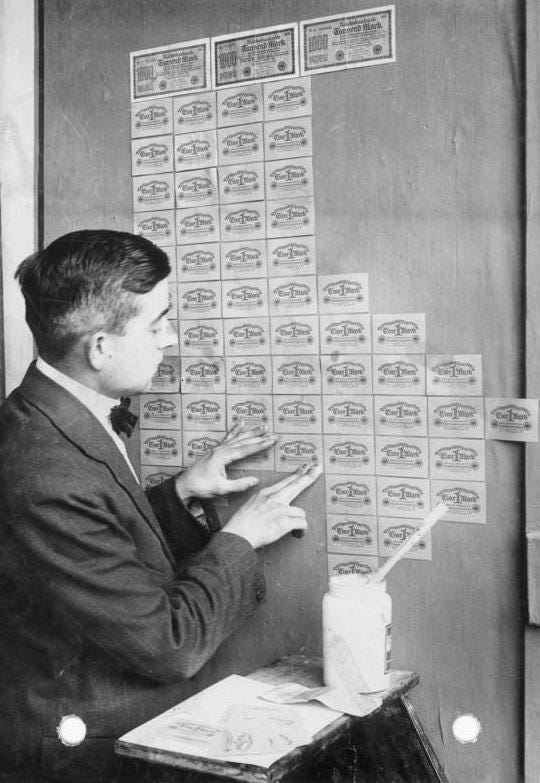
So it’s Weimar Germany. By 1923, the Kaiser’s gone, money isn’t worth the paper it is printed on, and Germans are wheelbarrowing cash down the street to buy bread. We have all seen the pictures and made the uncomfortable inflation jokes.

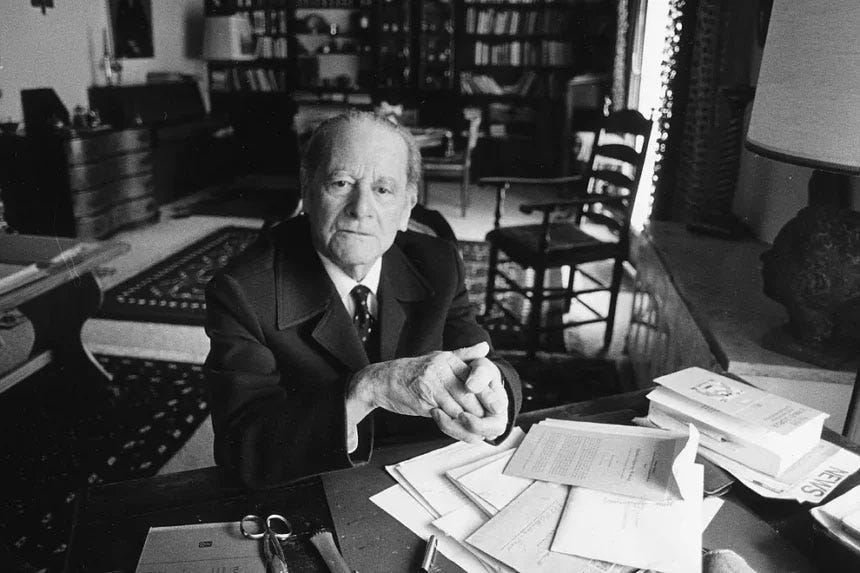
So there’s this little dorky law professor named Carl Schmitt. Catholic guy, very serious, the kind of man who irons his socks. In 1922, he writes this book, Political Theology, and the very first line, the FIRST line, he gets right into it:
“Sovereign is he who decides on the exception.”
Damn, that’s cold.
So what does it mean?
The idea itself is simple. Imagine a constitution as a rulebook. The rulebook explains who may do what, under which circumstances, through which procedures. Congress passes something, courts review, agencies follow rules, forms appear, meetings occur, and Karen returns from lunch.
Then the building catches fire.
Suddenly somebody says the normal rules cannot possibly handle this. We are in an extraordinary situation. Somebody must decide what can be suspended, bypassed, or done differently until normal conditions return.
Schmitt looked at that moment and said, essentially, there is your sovereign. The deepest political power belongs to whoever can decide that normality has ended.
And it’s basically a stab against those silly liberals and pleasant parliamentary folks who think the law is in charge. Rules…Constitutions? Pleeeeease.
Schmitt goes, ah no, sweetie. Rules only work when politics are normal. And who decides what is normal? Somebody has to look at a crisis and say, “This is an emergency, the rules are suspended now.” And whoever gets to say THAT, that guy is the real boss. Not the constitution. The guy who can turn the constitution off.
In other words, power is with the ruler, not the rules.
It’s like if a club says there is a dress code. There’s even a sign that says there is a dress code. But the sign doesn’t throw anybody out. The bouncer does. And the bouncer can let in some guy in Crocs and a mullet because he’s the bouncer’s cousin. The bouncer is the sovereign. The sign is just… decoration. So in Schmitt’s universe, Constitutions are just another sign with rules.
Then in 1927, he writes The Concept of the Political, and he says politics isn’t about policy or compromise. Politics is about two boxes: friend or enemy. That’s it. Every political question boils down to who is with us and who is with them.
However, the enemy isn’t the troll you debate on Facebook. It is the group you might actually have to fight — and ultimately kill. And Schmitt says liberals are wimps because they pretend there are no enemies, just people we haven’t compromised with yet. It’s like the entire purpose of liberalism is to make people sing along in this Panglossian campfire and pretend we can be civilized enough to get shit done.
He sums up his contempt with a line he swiped from the French anarchist Proudhon: “Whoever invokes humanity wants to cheat.” Meaning, anybody saying “we’re all one people” is running a con.
Not a cheery guy, that Schmitt.
But here’s where it gets really grim. Weimar has a constitution and a spiffy Article 48. Which means a President can declare an emergency and rule by decree. And Schmitt gets all lusty pants when anyone mentions Article 48. He argues the president should have vast emergency powers to save the republic from its enemies. In 1932, he literally went to court and argued that emergency powers could kick out Prussia’s Social Democratic government.
And you know who learned a lot from watching a republic get governed by emergency decree?
(Whispers cause I don’t want to dogwhistle the Nazi trolls…)
Hitler.
The numbers are bananas. In 1930, the Reichstag passed 98 laws, and the president issued 5 emergency decrees. By 1932, the Reichstag passed 5 laws, and the president issued 66 decrees. Parliament basically stopped being a parliament. It was a fainting couch.
Then, in February 1933, the Reichstag fire, an emergency decree, and civil liberties go poof. A month later, the Enabling Act drops, and it’s game over for Weimar and eventually the Jews.
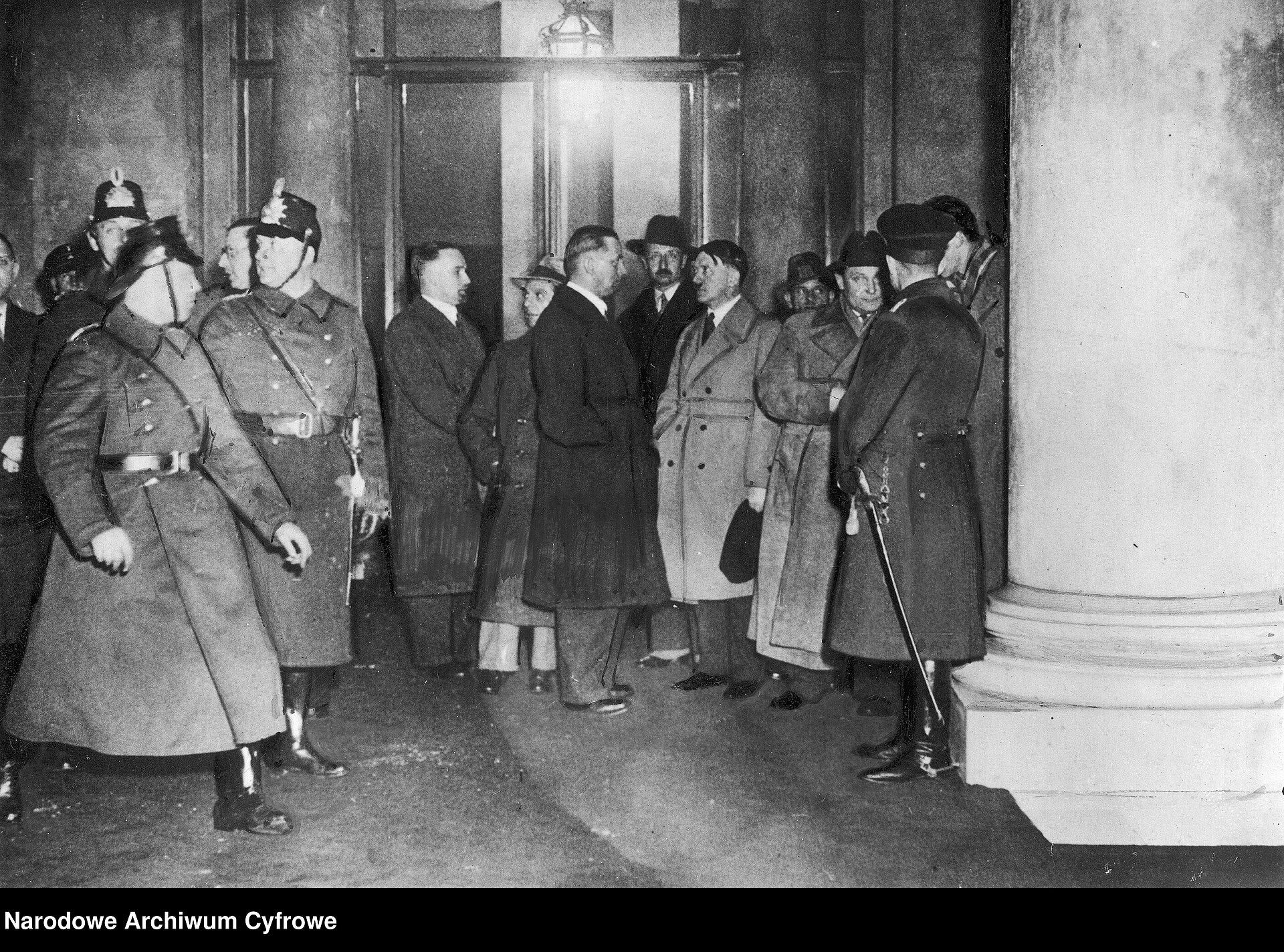
Meanwhile, Shmitty boy joins the Nazi Party on May 1, 1933. He is like that guy who shows up to the party right when the keg gets tapped. They call him the “Crown Jurist” of the Third Reich.
Flash forward to 1934. Hitler murders political rivals in the Night of the Long Knives — no trials, nothing. Schmitt answers with an essay called “The Führer Protects the Law” and declares that Hitler’s murders were “the highest justice.”
Then in 1936, he really rips the pants off of democracy. Schmitt runs a conference on purging Jewish influence from German law and pushes to have Jewish legal scholars identified in library catalogs and their books cleared out of law libraries.
Schmitt eventually gets his villain downfall. Sort of. The SS paper decides Schmitt is an opportunist, too Catholic, not a real Nazi, whatever that means. He gets pushed out of his party jobs, not because he was too evil. Because he wasn’t evil enough in the right fan club.
After the war, Americans lock him up, interrogate him at Nuremberg, and… never charge him. Idiots. He refuses to go through denazification. Never apologizes. Goes home to his little town, Plettenberg, lives to 96, and spends the next forty years having grad students make pilgrimages to his house like he’s a sexy old wizard.
To be clear, Schmitt is a full-blown antisemite, not just a careerist. And anyone who says differently is just wallpapering over history.
Okay, so why do Peter Thiel, JD Vance, and those guys love him?
Peter Thiel is kinda banal as far as scary antichrists go. In 2007, he publishes “The Straussian Moment,” — an essay shaped by 9/11 with an entire section called “Carl Schmitt: The Persistence of the Political.” Mr. Diabolical goes straight to Schmitt’s friend-enemy framework. Thiel does not swallow Schmitt whole. Instead, he warns that answering an enemy with Schmittian ferocity can turn you into the enemy. But politics still forces people to choose friends and enemies—very linear thinking for a supposed tech innovator.
Then in 2009, in Cato Unbound, Thiel drops his famous line: “I no longer believe that freedom and democracy are compatible.” Like, okay Peter, tell us how you really feel at Thanksgiving.
For Thiel, Schmitt is catnip because the whole Silicon Valley founder brain is already Schmittian. The founder is the sovereign. Boards, rules, and regulators are the boring liberal parliament. The genius decides.
Thiel also bankrolled Vance’s 2022 Senate run to the tune of $15 million, so… his ideas have a delivery system.
Now, Vance has not gone around adding Schmitt to campaign ads. That’s just rude. Besides, he doesn’t have to. He’s swimming in the water that Thiel and Curtis Yarvin poured. And listen to what Vance actually said on a 2021 podcast: fire every mid-level bureaucrat, replace them with our people, and when the courts stop you, do what Andrew Jackson did: “The chief justice has made his ruling. Now let him enforce it.”
In other words, “sovereign is he who decides on the exception.” The court says no, and the executive decides the court’s “no” doesn’t count. The rule only matters if the guy with the power agrees to obey it.
You can’t get more authoritarian than that.
Oh, but they sure did try. In February 2025, Vance posts that judges aren’t allowed to control the executive’s legitimate power. And who decides what’s legitimate? The executive. It’s a snake eating its own tail and calling it lunch.
Shortly after, Trump stops watching Fox News for two seconds and comes up with this zinger: “He who saves his Country does not violate any Law.”
Granddaddy thinks he is quoting Napoleon or something, but that’s just Schmitt wearing a red hat. Add in the stack of emergency declarations, and you’ve got a government that treats “emergency” less as a fire alarm and more as a master key.
Now, Schmitt wasn’t stupid. Constitutions really do have trapdoors. Yes, somebody decides when a crisis activates them. And liberals really can get mushy pretending everybody is reasonable. Chuck Schumer is a case study in pointless hall monitors.
But Schmitt’s trick is taking a true observation, “rules can’t enforce themselves,” and turning it into a sales pitch: “so let the strong man ignore them.”
It’s like your drunk uncle being right that the referee’s blind and concluding that you should be allowed to punch the goalie.
The authoritarian trick is to convince people the exception is temporary. But once the fire is out, and the enemy is defeated, their version of normal is all that remains.
Normal has been getting harder to find lately.
This year, V-Dem stripped the United States of its long-held status as a liberal democracy. America remains an electoral democracy, but the protections surrounding those elections — checks on executive power, rule of law, civil liberties, a free press — have weakened sharply.
In other words, we still have the ballot box. It is carrying more of the democracy now.
Which makes Trump’s refusal to rule out emergency powers around the midterms considerably less theoretical.
Everyone is watching November 3, but the trouble begins the day after.
Next, we’ll talk about the game plan for November 4. Subscribe to get my essays delivered to your inbox.

Carlyn Beccia is an award-winning author and illustrator of 13 books. The Grim Historian is a reader-supported publication. To receive new posts and support my work, consider becoming a free or paid subscriber.
thanks to our pro corruption supreme court. who doesnt care about the truth.
Bitch, Bitch, Bitch 🤣