


Grim Reminder: A Grim Historian is a reader-supported newsletter and depends on your 5$ donations to keep the most depressing politics and history in your inbox. Please consider becoming a paid subscriber or sharing with someone who loves misery.
Election officials are currently preparing for the usual Trump hijinks. They have enlisted poll observers, voter hotlines, lawyers, and elaborate escalation plans.
Everyone is nervous.
But recently, Michael Moore offered one genuinely reassuring detail about election security. (Not the Fahrenheit 9/11 guy. Reassurance is not really his wheelhouse.) No, this Michael Moore is the chief information security officer for the Arizona Secretary of State. And this guy understands how spectacularly sideways an election can go.
“We design exercises to give election officials the most miserable Election Day we can possibly imagine,” Moore recently told The Washington Post. “That way, when they actually have an election day, they’re prepared for everything.”
The Most Miserable Election Day sounds like the title of my next picture book. How miserable, Mr. Moore? Because now you have my attention.
Usually, the worst that happens is the white-haired election ladies run out of I Voted stickers or somebody shows up at the wrong precinct and demands to speak to democracy’s manager. But there is also the possibility of something more horrendous— bomb threats, cyberattacks, or violence. So election workers train for emergencies.
At least that is what I thought they meant.
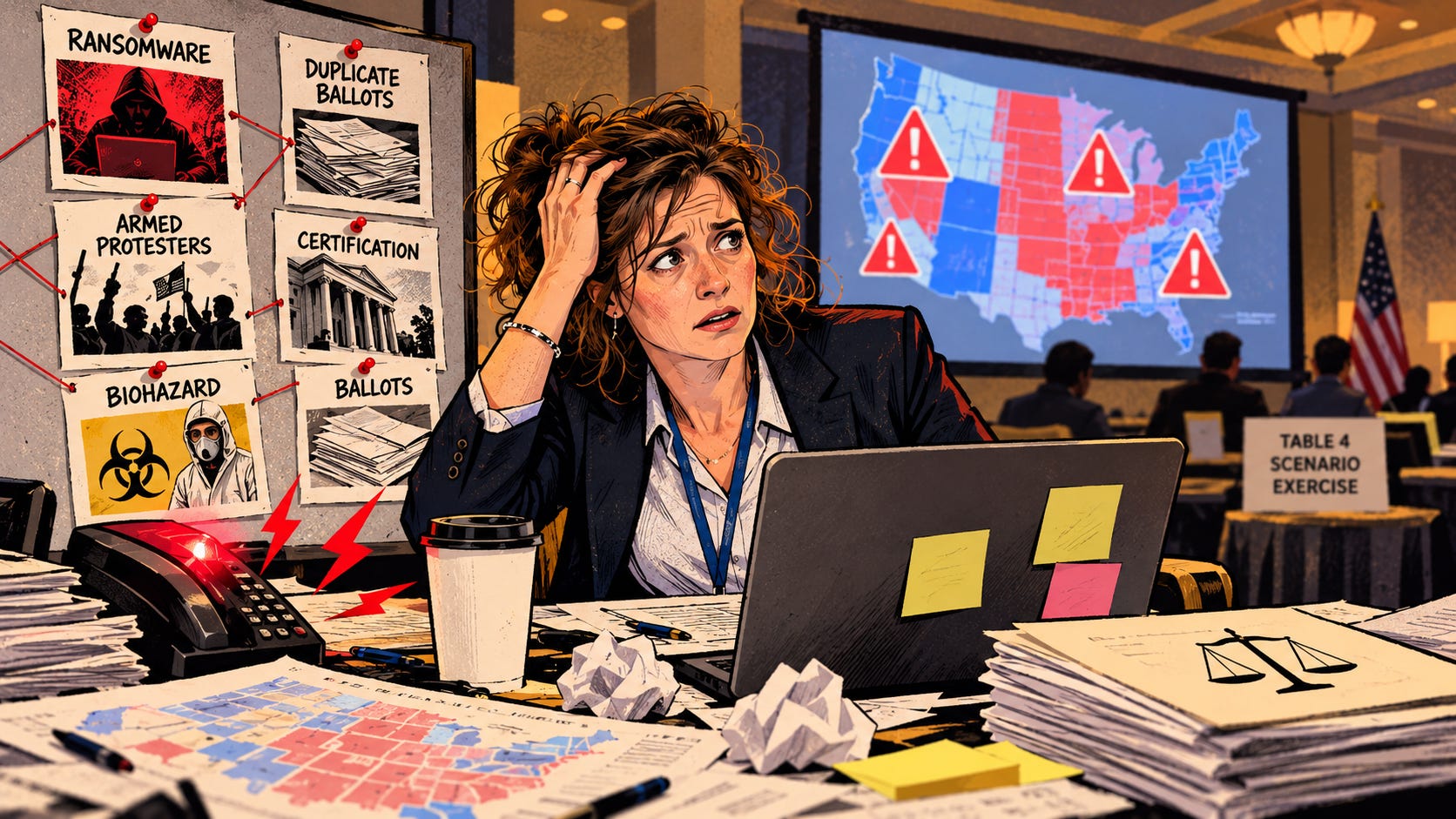
Then I found some of Arizona’s election training material. Apparently, at some point, Arizona Secretary of State's office was tasked with answering one question — how thoroughly can we torture an election official before somebody calls HR?
Let’s just say that by the end of the day, two people were dead, and someone was cleaning up human feces.
Not literally. But someone got paid to write an election day torture scenario. His name is Ken Matta, and he was the state's chief election security officer.
You can understand why I am jealous of Ken.
(Reminder to the Arizona Secretary of State: Forget Ken. I am available for hire. I have an impressive résumé in Italian history and medieval torture. I know my strappado from my Scavenger’s Daughter and can inject enough misery into Election Day to make this operation look professionally sadistic. You know where to find me.)
Anyway, here’s what went down on game day…
The Most Miserable Election Day Ever
It’s April 2022, and Lisa Marra is the elections director of Cochise County, a slab of Sonoran Desert bigger than Rhode Island and Connecticut combined. She has the kind of job nobody thinks about until it goes wrong — voter rolls, poll worker schedules, making sure the right ballot goes to the right precinct, etc. She’s been doing it for five years. It’s a boring job, and Lisa is very good at it.
So Lisa drives up to a Phoenix hotel for an election training exercise. The ballroom is packed full of election directors, IT staff, cops, and county officials who would rather be doing literally anything else.
Here are the election torture game rules: The game drops everyone into fictional Arizona counties. One is called Cactus County. (Somebody was paid to come up with that. What did I tell you? Amateurs.)
The team gets a budget, and it’s too small. Spend on phishing training, and you may not have enough left for public education. Every choice leaves something exposed.
Then the torture writers feed the participants disasters. Election officials call these little snafus “injects.” Writers call them plot beats — preferably the kind that make your protagonist’s day progressively worse.
So the first disaster lands.
Ransomware compromises files in the election and recorder’s offices. Hope Lisa bought the phishing training.
Then voters start calling. They received more than one ballot. Before Lisa can get her arms around that, politicians go on television and tell people not to mail those ballots.
Then they threaten to arrest election workers. Lisa’s election workers.
Next, the fictional legislature announces that it plans to audit Cactus County’s results using auditors whose professional experience includes working as “part-time carnival ride attendants.” (I admit, carnival attendants are a dark twist. I might have made one of them a ferret breeder, but I respect the craft.)
Now Lisa has decisions. She can call a press conference, fire an employee spreading misinformation, or plead for more resources. Katie Hobbs, then Arizona’s secretary of state, stands right there in the ballroom, so Lisa can even walk across the room and appeal directly to the dungeon master.
But while Lisa’s team tries to solve one crisis, her actual cellphone rings with another. Emails pile up. Fake breaking news flashes across the giant screen at the front of the ballroom. Then C. Murphy Hebert, a former reporter playing the press corps, starts demanding answers about why Lisa is running this entirely imaginary election so badly.
And Election Day hasn’t started yet.
When it does, the computers crash. Voters lose track of where they are supposed to vote and start hunting for their polling places. Lisa’s team is trying to keep the county upright when somebody decides the plot still lacks a certain diabolus ex machina.
So they drop in some human feces.
Apparently, at one point, Ken must have decided Lisa hadn’t suffered enough, so he thought—How about we smear the polling place with literal shit? That will get her attention. (I withdraw some of my earlier criticism about Ken’s writing. He may have potential.)
Now, your instinct is probably, Lisa… get a mop. Nope. Human waste is a biohazard. Poll workers cannot just grab a bucket and clean it up. Lisa now has to find people with protective equipment to clean the polling place, and somehow keep voters moving while the floor is contaminated.
Lisa is still dealing with the literal shitstorm when armed protesters arrive at election sites and start trying to check voters’ immigration status. Now Lisa has to decide whether they are intimidating voters, when to call police, and how long she can keep the polling place open before the danger escalates.
If she closes the polls, where does everybody vote? That question has teeth because Arizona counties do not all run elections the same way. Lisa’s fictional county uses vote centers, which means voters can go somewhere else if one location goes down. Other teams in the ballroom are running traditional precinct systems, where voters are assigned to a particular polling place. Tricky.
Then the protesters turn violent. So Lisa’s team closes its vote center and redirects voters.
Across the ballroom, another team is running a precinct system. They can’t close the polling place in time.
A fight breaks out. Two people die. Fake people, but still.
(And here I must lodge my first serious complaint. How did they die, Ken? Shot? Stabbed? Trampled beneath a mob of furious voters all dressed like the J6 Viking dude? You cannot spend an entire day lovingly constructing ransomware, carnival workers, human feces, and armed protesters and then get coy when you finally reach the body count. Frankly, I could have done better.)
Meanwhile, Lisa has learned the lesson before the imaginary bodies were cold. If you wait until violence breaks out to start debating whether a polling place should close, you have already waited too long. You need to know who can make the call and where voters go next before the armed men arrive.
“It’s just like how law enforcement trains,” Lisa explains. “They train for like the worst scenarios with simulated stress and immediately thinking on your feet under pressure.”
This poor woman is literally doing combat training in business casual. Someone should probably check whether the employee assistance plan covers post-traumatic election disorder. I am not sure we are paying Lisa enough.
So to recap: By the time somebody finally releases Lisa from Cactus County, she has been hacked, threatened, interrogated by the press, stranded by crashed computers, chased by confused voters, confronted by armed protesters, and forced to formulate an emergency response to human feces.
All in a hotel ballroom. All before dinner. The narrative arc may need some room to breathe. Lisa may need a therapist.
Eventually, the polls close. The armed men leave, the fake reporter goes home, and Lisa washes her hands. Repeatedly.
But here is where we stop laughing, because Lisa’s election isn’t over.
Neither is yours.
Because the day after, November 4th, is harder to drill. That is when injects look like paperwork — a ballot counted after Election Day, a number that changes, a lawsuit, or a request for records. Each one can be perfectly normal. Each one can also be an attack.
From your couch, they look identical, unless you know what normal looks like.
And this cycle, we already have the receipts. Reuters reported in September that the Trump regime has sought greater federal involvement in running state elections. They have demanded confidential voter information, pursued election-related investigations, attempted new mail-ballot rules, pushed redistricting, and investigated election offices.
Earlier this year, federal agents seized hundreds of boxes of old election records in Fulton County. Now, election officials in several states are preparing legally for attempts to obtain their voting equipment or records.
Americans have been taught to watch the voting. We have not been taught to watch what happens to the vote afterward.
The Most Miserable AFTER Election Day Ever
So here’s YOUR torture drill. I gamed it myself. And I really restrained myself from my usual grim proclivities. You’re welcome.
Election night: the unofficial count
The numbers on your TV are the fastest reliable accounting officials can give the public. But election-night numbers are never the final certified results. Even “100% of precincts reporting” doesn’t mean finished. Unofficial numbers move for days.
The inject: “THE NUMBERS CHANGED.” THEY CHEATED!!!
Normal. That is what unofficial means. Election officials continue processing lawful ballots, and the totals change with them. A changing number tells you the count changed. By itself, it tells you absolutely nothing about why.
The ballots that take longer
Some ballots can’t be counted on the spot. Officials keep provisional ballots separate until they confirm voter eligibility. Mail ballots arrive and get verified under each state’s rules. Military and overseas ballots trickle in. Some ballots need a human to decide what a voter meant. All of this happens after Election Day, by design.
The inject: “THEY FOUND FAKE BALLOTS.”
Nope. Late doesn't mean fake. They set them aside on purpose, and now they’re counting them on purpose.
The canvass
This word desperately needs translating, because it sounds like Lisa going door to door selling Girl Scout cookies. It means that election officials must make the books balance. How many people signed in, how many ballots came back, how many got counted, and where’s the gap? The EAC calls it the process of confirming every valid ballot, from Election Day, early, mail, provisional, military, and overseas voting.
The inject: The board whose job is to sign the canvass decides its signature is optional.
Not normal. The exact duties vary by state, but where certification is mandatory, officials cannot simply refuse because they distrust the result. We have already watched this happen. In 2022, the New Mexico Supreme Court ordered Otero County commissioners to certify after they refused. That same year, a judge ordered Cochise County supervisors to certify after they blew past Arizona’s deadline, ruling that certification wasn't optional.
Remember this one. It’s coming back.
Audits and recounts
Most states run some post-election audit, checking the machine count against the paper ballots. A recount is a different animal. It actually recounts a specific contest, usually a close one, and it can change the official total. Both are normal.
The inject: Somebody demands a “forensic audit” by people whose résumés would have fit right in at Cactus County. Or federal agents show up asking for the voting equipment you are still using to finish the damn election.
Not the same thing. A statutory post-election audit performed under the state’s rules is normal. Federal agents demanding active election equipment during counting or certification is not routine.
Certification
Only after the work is done do officials certify, formally attesting that the numbers are the true result under their state’s law. This takes days or weeks, on deadlines set by state law. It shouldn’t happen five minutes after Wolf Blitzer colors in a map. And there definitely shouldn’t be any hanging nooses calling for heads.
The inject: A lawsuit filed to buy time.
Could be normal. Could be trouble. It depends on the reason behind the stall. Lawsuits are one lawful way candidates challenge elections. A court can order relief when something actually went wrong. Filing a lawsuit does not, by itself, mean democracy is under attack.
Seating
For Congress, there’s one more gear, and it’s the one that keeps me up at night. The Constitution makes each chamber the judge of its members’ elections, returns, and qualifications. A winner does not become a sitting member until the oath is administered. When the new House convenes on January 3, it decides whom it seats.
The inject: The voters elect someone. The state certifies the winner. Congress simply…doesn’t seat them.
Not normal. The House does have constitutional authority to judge its members’ elections and qualifications so that a genuine dispute can delay seating. But once a winner has been certified and there's no unresolved qualification fight, simply leaving the seat vacant is not ordinary election administration.
We have a recent preview for this one. Adelita Grijalva won Arizona’s 7th District in a special election on September 23, 2025. Speaker Mike Johnson didn’t swear her in until November 12th — 50 days later.
She happened to be the 218th signature on the petition to force a vote on the Epstein files. Johnson said the delay had nothing to do with the Epstein vote. Suuuuuure.
Most Miserable No Good Election Day Postscript
In April 2022, Lisa Marra survived Cactus County. In November 2022, she ran the real thing in Cochise County. No feces that I know of.
Instead, her bosses attacked her.
Two Republican county supervisors wanted a 100% hand count of the ballots, including early ballots. Marra told them to follow state law. So they sued her. Personally. Then they deliberately missed the legal deadline to certify the county’s results, throwing Arizona’s entire statewide election certification into chaos.
A judge had to order them to do their job. They certified on December 1. One of them skipped the meeting.
In January 2023, Marra resigned, citing an “outrageous and physically and emotionally threatening” workplace. The county later paid her a $130,000 settlement.
Arizona drilled Lisa for armed men, deepfakes, and a shit-smeared polling place. Nobody drilled her for a missing signature. You can’t hand out hazmat suits for that.
Now, everyone is predicting a tumultuous election upheaval on November 3rd with lots of Trump temper tantrums. But sometimes a contested election can look like boring paperwork.
Thankfully, election officials have spent years rehearsing these worst-case scenarios.
Our job is easier.
We just have to know what normal looks like.

Carlyn Beccia is an award-winning author and illustrator of 13 books. The Grim Historian is a reader-supported publication. To receive new posts and support my work, consider becoming a free or paid subscriber.
I'm an election worker in GA and you're correct about this. I suggest you check out This Will Hold Substack. It will open your eyes on elections and 2024 in particular. Electronic voting has been compromised for many years.
I notice your writing style shifted a bit for this edition. If you're feeling rattled by all this, well, so am I...