

Every State That Builds a Second Army Learns the Same Hard Lesson
When a regime creates armed bodies that answer to ideology, a leader, or a mission rather than law, a collision is inevitable.

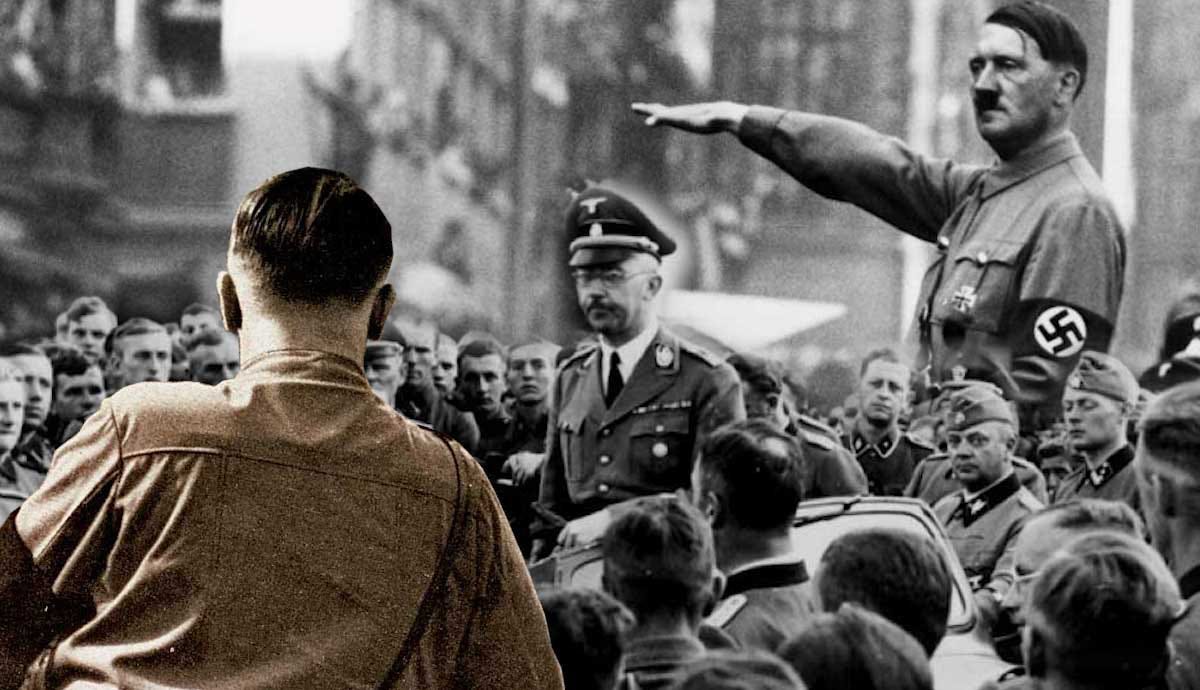
This post is Part 2, examining the consequences of a paramilitary army. In Part 1, we explored the dangerous ideologies. In this post, we explore the economics and shear logistic stupidity of nations that fund dual armies.
Grim Reminder: A Grim Historian is a reader-supported newsletter and depends on your 5$ donations to keep the most depressing politics and history in your inbox. Please consider becoming a paid subscriber or sharing with someone who loves misery.
Vladimir Putin is laughing at us. He’s laughing because he knows what happens when a state funds two parallel crime-fighting armies.
He knows because he lived through it.
In the early 2010s, Putin decided regular armies were annoying. They had rules, paperwork, and generals who expected promotions. So he accidentally on purpose allowed a side hustle: a private mercenary army called Wagner, run by a hot-dog-selling ex-con, Yevgeny Prigozhin.
Wagner does Russia’s dirty work: Syria, Africa, Ukraine. No uniforms, no laws, vibes only. Putin likes this because if Wagner commits war crimes, he can shrug and say, “Who? Never met them.” Classic.
Only one problem. Wagner starts winning battles that the real Russian army is losing. Prigozhin gets loud. Very loud. He posts videos screaming that Russia’s generals are idiots, traitors, and possibly drunker than him.
Then in June 2023…Prigozhin snaps. He points Wagner’s tanks at Moscow. Actual tanks. This is not metaphorical. They drive hundreds of miles to shoot down Russian helicopters. The army mostly steps aside like, “Uh, is this a drill?”
It was not a drill. For 24 hours, Russia discovers it has two armies and zero control. Putin gives a panicked speech about betrayal. Deals are made. Wagner stops short, and Prigozhin is “forgiven.”
And by forgiven, I mean two months later, Prigozhin’s plane falls out of the sky.
Putin’s Russia isn’t the only example. Many regimes throughout history believed two armed forces could coexist…until Dear Leader had to choose.
Rome: A Tale of Two Underfunded Armies
Rome’s collapse wasn’t sudden or theatrical; it was transactional. In the late Republic, soldiers were no longer paid reliably by the Senate. Campaigns stretched longer, land grew scarce, and pensions became promises rather than policy.
That’s when Marius, then Sulla, then Caesar filled the gap with cash, loot, and land grants. A legionary didn’t fight for Rome; he fought for the man who would retire him.
By the time Caesar crossed the Rubicon with a single legion, Rome technically still had one army. In reality, it had several, each owned by a patron with a better benefits package.
The lesson? Parallel forces never stay parallel. Loyalty follows money.
Iran: Money, not might, builds the strongest army
Iran made the split intentionally. After the 1979 revolution, the new regime didn’t trust the existing army, so it created the Islamic Revolutionary Guard Corps as a political insurance policy — ideological, loyal, and lavishly funded.
Over decades, budgets told the story. The Guard gained control over missiles, intelligence, foreign wars, and vast chunks of the economy, while the regular army became ceremonial muscle.
The state didn’t lose control overnight; it surrendered it quietly, line by line.
Nazi Germany: may the best uniform win
The SA and the SS were not interchangeable Nazi goon squads. They played very different roles in the ecosystem of power.
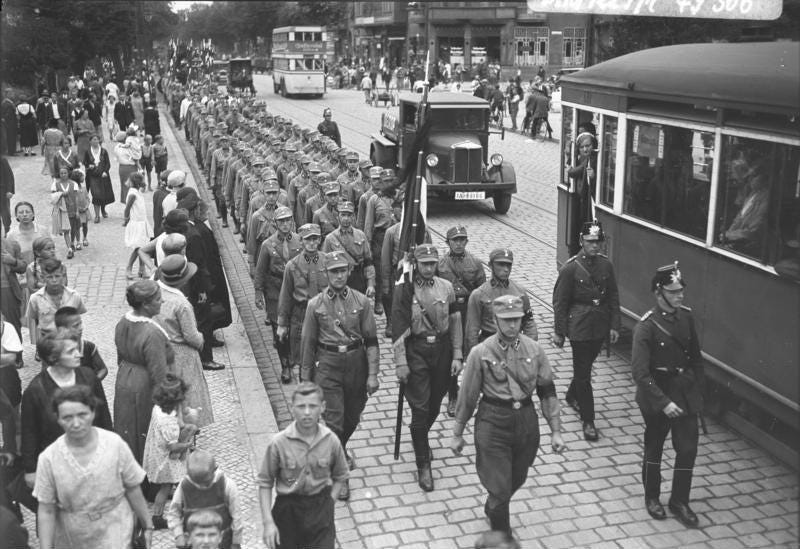
The SA (Sturmabteilung) — the brownshirts — were the street muscle. They brawled with communists, tortured and murdered Jews, intimidated voters, smashed presses, and turned rallies into riots. They were loud, numerous, undisciplined, often embarrassing, and increasingly threatening to Germany’s elites and its professional army.

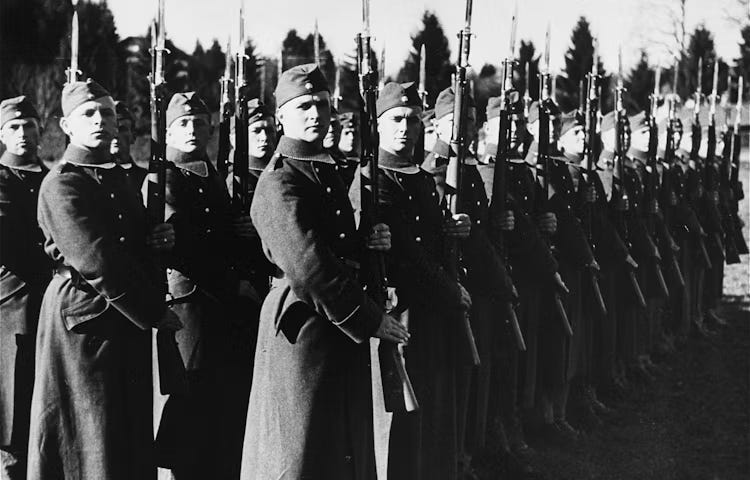
In contrast, the SS (Schutzstaffel) began as Hitler’s personal bodyguards and evolved into a disciplined, bureaucratic terror machine: running concentration camps, intelligence operations, racial “science,” and eventually mass murder. The SS was smaller, quieter, better dressed, and obsessively loyal upward. It didn’t riot; it kept lists.
The power dynamic was simple: the SA helped seize power; the SS helped keep it. And for a while, Hitler tolerated two armed forces because both were useful.
Until they were not.
Once the SA demanded influence and threatened the SS army and elites, they had to go. In 1934, during the Night of the Long Knives, Hitler chose. SA leaders were arrested, executed, erased. No civil war. No chaos. Just paperwork, gunshots, and promotions. The regime didn’t reject violence — it refined it.
That’s the thing about tyrants. They may love a good crisis in the beginning as a ruse to topple democracies, but they don’t reward chaos forever. They eventually choose control. And once that mechanism locks into place, it is often too late.
Mussolini’s two-force fiasco
Mussolini didn’t abolish Italy’s army or police; he just lost faith in adults. The Italian state already had soldiers, courts, and the Carabinieri — institutions weighed down by laws, budgets, and the maddening expectation that force be justified. This was far too much friction for a man in a hurry.
So Mussolini did what impatient authoritarians always do: he built a second force — the Blackshirts. These men were cheaper, louder, and loyal to him personally.
In the short term, it felt brilliant. Procedure could be skipped. Opponents could be intimidated. Violence could be outsourced without leaving fingerprints on the doorknob. But the logistics were a mess, and the economics were worse. Two forces meant two chains of command, two definitions of authority, and a steady escalation in brutality as each group proved its usefulness through increasingly theatrical violence.
The regular police hesitated, unsure where their jurisdiction ended; the Blackshirts, unburdened by discipline, treated restraint as a personality flaw.
Predictably, civilian trust collapsed, enforcement costs ballooned, and Mussolini found himself spending more time refereeing his own goon squads than governing Italy. Eventually, he folded the Blackshirts into the formal state. Not because the experiment worked, but because it didn’t.
The Grim History lesson? Parallel forces don’t stabilize regimes; they turn governance into a knife fight. Mussolini chose consolidation too late. By the time order was reasserted, the rule of law had already become a prop, and Italy had traded governance for intimidation — a bargain history has never honored.
America: The mistakes we repeat
After George Floyd’s murder, police departments and community leaders nationwide spent years trying to rebuild trust and legitimacy, investing in community policing, de-escalation training, and mental-health responses so officers could be partners instead of occupying forces in the neighborhoods they patrol.
And it worked. Under the Biden administration, federal support for community policing grew. America invested millions in grants to hire officers who reflect local demographics. We trained police forces on use-of-force standards and bias, and we funded mental-health and crisis-response co-teams.
Was it perfect? No. But we were headed in the right direction. Overall, these measures kept violence down and trust up.
Then came Trump.
After taking office, the Trump regime rolled back Biden’s policing reforms and ripped up Executive Order 14074 aimed at law enforcement accountability and transparency.
Of course, Trump branded Biden’s actions as woke “defunding” of the police. Now, when people hear “defund,” they panic and picture our police in thrift-store uniforms playing tag with tasers while criminals run wild.
Please. Settle down, MAGAmuffins. Or better yet, turn off Fox News and take a cold shower. “Defund” does not mean weaken the good guys. It means we move money to better tools and accountable institutions. Defund is basically an audit with consequences.
And we already have some damn effective defunding examples.
When the Office of Strategic Services was shut down in 1945, the U.S. didn’t renounce intelligence gathering. Instead, it killed a sprawling wartime agency whose powers only made sense during global chaos. Then, the US rebuilt its core functions two years later inside the newly created CIA, with a formal charter and congressional oversight.
Same pattern with the IRS. After a string of abuse scandals — most notably in the 1990s, when the agency was caught with its pants down aggressively screwing over low-income taxpayers while missing billions in high-dollar noncompliance. Congress responded by slashing enforcement authority, reorganizing leadership, and passing the IRS Restructuring and Reform Act of 1998. Senators hauled officials before hearings, waved spreadsheets showing lopsided audits, and made it clear: collect taxes, yes; terrorize the wrong people, no. The point wasn’t to end taxation — it was to stop funding a bloated bureaucracy that was bad at its actual job.
And then there is the most on-the-nose example — immigration. During his eight years in office, Obama’s administration oversaw the deportation of roughly 3 million people — more formal removals than virtually any president in modern history.
Those deportation numbers didn’t happen because ICE was turned loose to roam cities with masked, gun-toting goons. Instead, Obama’s administration prioritized removals through legal channels, judges, and structured casework, and used streamlined enforcement (e.g., coordinated interior arrests and court-ordered deportations) rather than militarized raids.
In other words, instead of deporting undocumented immigrants by raiding cities with a taxpayer-funded paramilitary army, Obama ran deportations through the courts…as a functioning democracy would.
And guess what? The boring approach worked. Turns out the rule of law is faster — and deadlier — than brute force when you actually fund it.
Every time an ICE agent gets a badge, a taxpayer loses their wings
What we should be screaming from the rooftops is this: who the hell is paying for all of this?
ICE’s budget has exploded to tens of billions, with supplemental funding that now dwarfs many other federal law enforcement agencies. Meanwhile, Trump has proposed a $1.5 trillion military budget next year, up steeply from around $901 billion today, putting hard limits on what taxpayers can actually afford. The surge of 2000 agents on Minneapolis streets after the Renee Good killing, and the massive federal occupation that local leaders say is terrorizing communities — all of it comes from somebody’s paycheck.
I find it darkly ironic that the MAGAmuffins and good Christians cheering this brutality will be the same people paying for it. The lawsuits won’t be funded by vibes. They’ll come out of taxpayers’ wallets.
Just yesterday, a video circulated of a disabled woman, trying to get to her doctor’s appointment, being ordered out of her car during a federal operation. According to the footage, she didn’t move fast enough — or not in the way the ICE agents wanted. So federal agents smashed her window, cut her seatbelt, and forcibly pulled her out of the vehicle.
Those facts aren’t in dispute; they’re on camera. Whether she “mouthed off,” as the usual suspects now claim, is legally irrelevant. Insolence is not a crime. And none of this senseless barbarianism answers the only question that actually matters: how is this making anyone safer?
A better question — one Republicans in power seem allergic to asking — is this: Are we getting better safety for lower cost?
The answer is plainly no.
We fund brute force because politics loves muscle, not because it delivers justice. Every smashed window, every unnecessary extraction, every viral clip feeds a pipeline of civil-rights claims, medical bills, settlements, and consent decrees.
Redirecting that money to courts and due process — as the Obama administration did to achieve record removals through legal orders rather than militarized occupation — would be cheaper, more effective, and more constitutional. Instead, we’re paying a premium for spectacle, violence, and lawsuits.
Congratulations, Trump regime, you’ve weaponized cruelty as content. All of this spectacle violence has one purpose: to fuel recruitment and feed the base’s appetite for immigration enforcement porn.
The theater is not cheap. What ICE is doing right now is the opposite of what a well-funded police force would do. DHS has openly poached trained officers with $50,000 signing bonuses, 60K loan-repayment carrots, and fewer local constraints, pulling experienced cops out of departments that require civilian oversight and community accountability. DHS is basically robbing Peter (its police force) to pay Paul (thugs with more aggression than restraint).
Poaching your own police force alone is just bad economics. Local taxpayers pay to train officers, ICE swoops in and grabs the finished product, and communities are left understaffed, burned out, and more dangerous.
Our Founding Fathers saw this moment coming
Recently, Governor Walz threatened to deploy the National Guard to counter federal escalation. We are in a dangerous moment in history. States raising militias against a federal force is not normal politics. It’s Civil War architecture creaking back into view.
James Maddison would like a word. Back in 1787, America just escaped a king and redcoats in their living rooms and said, absolutely not, never again.
So they booby-trapped power: no permanent armies without congressional babysitting, no money without a two-year leash, militias split between state hands and federal rules. James Madison — always the practical one — knew armed men would drift toward whoever fed them best.
Madison didn’t even hint. He spelled it out for future generations in Federalist №41: “Standing armies are dangerous unless tightly controlled by civilian authority.”
When you have citizens murdered and brutally rounded up like cattle for exercising their First Amendment rights to peacefully protest, you have lost the narrative. (Unless your narrative is “Let’s Make America like Nazi Germany.)
This is why our Constitution reads less like a love letter to liberty and more like a paranoid safety manual written by men who had watched republics bleed out. Our Founding Fathers feared uniforms that answered upward, not outward. Those men mistake unlawful orders for legitimacy.
Cut the funds, starve the beast
There is a way out of this mess if we could find a few adults in the room. Congress doesn’t need to abolish ICE to rein it in. It controls the purse strings. It can refuse to expand a force that has proven expensive, violent, and legally radioactive, and instead redirect funding to immigration courts, judges, asylum officers, and due process. That isn’t radical. It’s how Obama achieved record removals without turning American cities into war zones.
Right now, a bill is winding its way through Congress to increase ICE’s budget. Citizens are not powerless. Call Senate Minority Leader Chuck Schumer and demand he oppose increases to ICE’s budget and condition funding on accountability.
Call House Appropriations Committee members and insist they strip militarized enforcement funds and reallocate them to immigration courts and judges. Reach out to your own senators and representative — 224–3121 will connect you to their offices.
Write to subcommittee leaders like Sen. Patty Murray, Sen. Chris Murphy, and members of the Homeland Security appropriations subcommittee, and tell them the cost of brutal raids and terrified communities is coming out of their budgets if they don’t act.
Demand that Congress use its oversight power to hold DHS and ICE accountable, not rubber-stamp another escalation. Action isn’t symbolic. It’s the only brake between parallel forces colliding and law-abiding citizens paying the legal and financial price.
History is very clear about the consequences of choosing silence. When states fund parallel forces instead of lawful institutions, control doesn’t increase — it fractures. And when those forces collide, the army left standing is not always the lawful one.

Carlyn Beccia is an award-winning author and illustrator of 13 books. The Grim Historian is a reader-supported publication. To receive new posts and support my work, consider becoming a free or paid subscriber.
Very well written and informative.
Disarm and unmask ICE. Make those proposals conditions in the discussions concerning further government funding, which expires in two weeks.